Solicor is a color-through decorative laminate from Wilsonart designed to reduce the dark edge lines commonly associated with traditional high-pressure laminate. Instead of using the familiar brown kraft-paper core, the material uses a core color selected to coordinate with the decorative surface. This creates a cleaner visual transition at exposed edges and helps fabricated furniture, counters, casework, doors, shelving, and other interior components look more unified. Wilsonart describes Solicor Laminate as high-pressure decorative laminate available with a color-through core in selected patterns and finishes. The standard laminate is still a surfacing material rather than a structural panel, so it normally needs to be bonded to a suitable substrate. A separate Solicor Compact product has also been produced as a self-supporting compact laminate panel for applications that need a thicker structural panel. Understanding that distinction is important because the two materials should not be treated as interchangeable. The main reason designers choose the standard product is visual: exposed edges can coordinate more closely with the face instead of revealing a contrasting brown line. At the same time, selection should still account for fabrication, substrate, finish, intended use, moisture, heat, and current design availability.
What Is Solicor Laminate?
Solicor is part of Wilsonart’s high-pressure decorative laminate offering. Wilsonart’s technical data identifies Types 160 and 161 as general-purpose high-pressure laminate intended for horizontal and vertical interior applications where a durable decorative surface is required. Its construction differs visually from conventional brown-core laminate because decorative papers impregnated with melamine resins are pressed over a specially prepared decorative paper core. The core is selected to coordinate with the surface design, producing the color-through appearance that defines the product. This does not mean the sheet is a solid slab of one homogeneous material like natural stone or some solid-surface products. It remains an engineered laminate made from resin-impregnated papers compressed under heat and pressure. The distinction matters during specification because the product retains the fabrication and installation characteristics of laminate while offering a different edge appearance. Wilsonart says its standard color-through laminate is suitable for furniture, fixtures, casework, interior doors, divider systems, and other interior applications. The current product page also highlights desks, countertops, display cases, lockers, cabinetry, partitions, elevator panels, shelving, wall panels, specialty furniture, and doors as possible applications.
Why the Color-Through Core Matters
The most recognizable feature of Solicor is not simply the pattern printed on its face. It is the way the core affects exposed edges. Conventional high-pressure laminate commonly has a darker core that becomes visible where a finished sheet is cut. On light-colored furniture or a design intended to look visually continuous, that narrow dark line can become noticeable. Wilsonart developed its color-through approach to reduce that contrast by coordinating the core with the decorative design. Its current product information describes this as eliminating the traditional laminate seam line and creating a cleaner edge-to-surface transition. This can be particularly useful on desks, shelving, counters, display fixtures, doors, and furniture where exposed edges are part of the design rather than hidden from view. The effect should still be evaluated with an actual sample. A coordinated core does not mean every pattern becomes visually identical through the entire thickness, especially with stone, woodgrain, linen, or other patterned surfaces. It means the underlying core color is chosen to work more naturally with the decorative face. For projects where edge appearance is a major design detail, viewing both the face and a fabricated edge is more useful than selecting from an online image alone.
Solicor Is Different From Ordinary Brown-Core Laminate
The practical difference between Solicor and standard laminate becomes easiest to understand at the edge. Both belong to the broader high-pressure laminate family, but conventional laminate often reveals a brown or dark core after cutting. That edge can be perfectly acceptable in many applications and may be covered or treated during fabrication. A coordinated color core offers another option when the edge itself should contribute to the finished appearance. Wilsonart explains that the product is engineered on the foundation of its HPL and that the key difference is the design-matched core color. This means buyers should not assume that choosing the color-through version creates an entirely different category of countertop or furniture material. It remains laminate and should be specified, fabricated, supported, and maintained with that fact in mind. The advantage is strongest where a clean edge detail matters. On a project where every laminate edge will be concealed by another material, edge treatment, or construction detail, the visual benefit may be less significant. Material selection therefore works best when it starts with the actual design problem rather than the assumption that one product is automatically better for every interior application.
Where Solicor Can Be Used
Wilsonart lists a broad range of interior uses for Solicor, including contract furniture, fixtures, casework, interior doors, and divider systems. Its current marketing material expands the examples to desks, countertops, display cases, lockers, cabinetry, partitions, elevator panels, shelving, wall panels, specialty furniture, and doors. These applications share an important feature: the decorative surface and its edge can remain visible as part of the finished design. A retail display, for example, may contain many shelves and exposed corners. A reception desk can have several visible edges that influence how refined the finished piece looks. Cabinetry and furniture can also benefit from a coordinated edge where a traditional dark laminate line would interrupt a pale or carefully controlled color scheme. Suitability still depends on the construction behind the decorative surface. Standard Solicor is not a structural sheet and must be bonded to a suitable substrate. That makes proper specification more important than simply choosing a pattern. A designer or fabricator should consider the substrate, adhesive, edge treatment, surface orientation, expected wear, and installation conditions together rather than treating the decorative sheet as a complete assembly by itself.
Standard Solicor and Solicor Compact Are Not the Same
One of the most useful distinctions for anyone researching Solicor is the difference between the standard laminate and Solicor Compact. Standard Types 160 and 161 are thin high-pressure decorative laminate sheets that require a suitable supporting substrate. Wilsonart’s technical data specifically states that the standard material is not structural. Compact laminate is different. Wilsonart describes Solicor Compact as a self-supporting high-pressure decorative laminate panel with a color-through core. Historical technical documentation lists compact applications across healthcare, commercial interiors, residential settings, education, and transportation, including furniture, partitions, wall paneling, lockers, laboratory bench tops, tables, window sills, and interior fittings. Compact panels have been offered in substantially greater thicknesses than the standard laminate sheet. That difference changes fabrication, detailing, weight, edge appearance, and potential application. A specification calling simply for “Solicor” can therefore be incomplete if it does not identify which construction is required. Current product availability should also be checked because collections, dimensions, patterns, and finishes can change. The correct choice depends on whether the project needs a decorative sheet bonded to another material or a compact self-supporting panel designed to function differently.
Available Colors, Patterns, and Finishes
Solicor is not limited to a single plain color. Wilsonart’s current product information groups designs into solid colors, textile-inspired looks, stone visuals, and woodgrains. This gives designers more freedom to use the color-through concept without limiting a project to simple white, black, or gray surfaces. The manufacturer also explains that only a selected group of Wilsonart designs is available in the product, so it should not be assumed that every pattern in the broader laminate library can be ordered with a coordinated core. Current finish availability also depends on the design. Wilsonart’s product FAQ identifies High Gloss, Matte, and Gloss Line among finishes available for certain standard selections, while its design library should be checked for current combinations. Historical brochures show that patterns, finishes, sheet sizes, and core colors have changed or expanded over time. For that reason, an old catalog can be useful for understanding the product but should not be used as the final source for ordering. The safest process is to choose a desired visual direction, check current pattern availability, order a physical sample, and examine both the decorative face and cut edge under the lighting expected in the finished room.
How Solicor Is Fabricated
Fabricators familiar with high-pressure laminate will recognize much of the process used with Solicor, but the manufacturer’s instructions still matter. Wilsonart states that special cutting tools are not required and that standard carbide-tipped tools routinely used for high-pressure laminate can be used. The product’s back is sanded for bonding, and Wilsonart says rigid-set PVAs and non-pigmented contact adhesives can be used according to its fabrication guidance. The company also points out a handling difference: because the product uses melamine resin, it does not roll as tightly as typical brown-core high-pressure laminate. It should be stored indoors and horizontally, while sheets are carried vertically on edge. The product is also not postformable because its resin is thermally set. These details can affect workshop planning. A design that requires tight postformed curves should not be specified on the assumption that every laminate behaves the same way. Clean fabrication is especially important because the edge is one of the main visual reasons for choosing a color-through product. Chips, poor cuts, unsuitable adhesives, or rough finishing can undermine the seamless effect that the material is intended to create.
Substrate Selection Still Matters
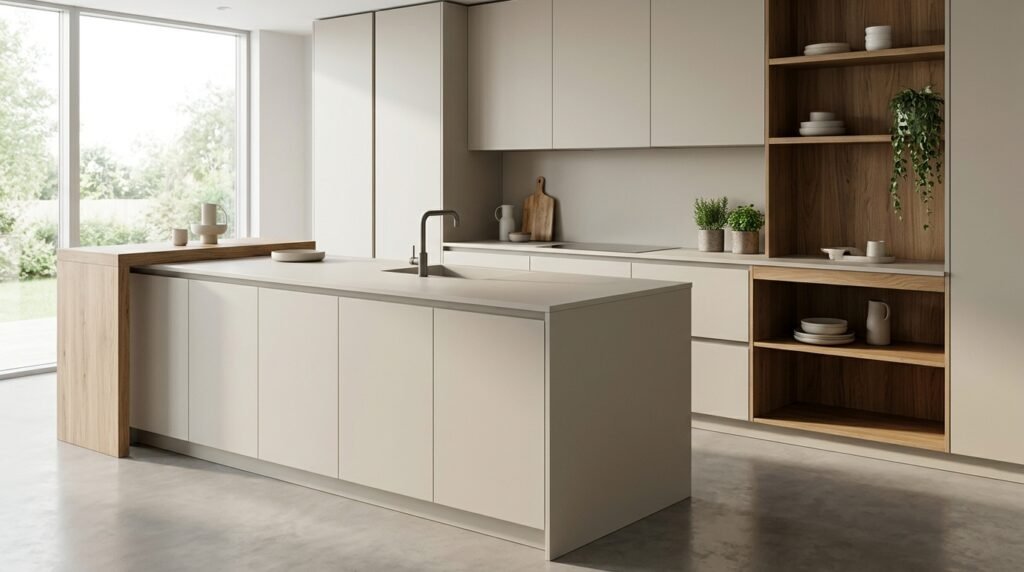
Standard Solicor cannot simply be installed as an unsupported thin panel. Wilsonart identifies it as a nonstructural interior surfacing material that must be bonded to a suitable substrate. The substrate contributes stiffness, flatness, dimensional stability, thickness, and the physical form of the finished component. This is why a laminate countertop, cabinet component, door, or furniture panel should be considered as an assembly rather than only as its decorative face. The manufacturer’s technical data also states that the standard laminate is not recommended for direct application to plaster, concrete walls, or gypsum wallboard. Proper substrate selection should therefore be coordinated with the intended use and fabrication system. A horizontal work surface may face different loads from a decorative vertical panel. A door may require different construction from a shelf. The adhesive must also be compatible with the materials and installation conditions. If a project needs a self-supporting panel rather than a thin decorative surface bonded to a core, a compact laminate product may be more appropriate. Confusing these constructions can lead to unrealistic expectations about strength and installation, even if the decorative appearance seems similar in photographs.
Durability and Everyday Performance
Wilsonart positions Solicor as a durable interior surface designed to resist scuffs, scratches, stains, and wear in appropriate applications. Its technical data identifies Types 160 and 161 for horizontal and vertical uses requiring a functional, durable decorative surface. That does not make the material immune to damage. Laminate should still be used according to the manufacturer’s limitations, and the demands of the specific application should be considered. A lightly used wall panel and a busy commercial counter do not experience the same abrasion, impact, heat, cleaning, or moisture exposure. Edge quality also matters because an exposed edge receives direct contact that a concealed edge does not. Historical technical data reports performance testing against applicable laminate standards, but designers should consult current technical documentation when a project depends on a specific fire, wear, chemical, or code-related performance requirement. Marketing descriptions such as “durable” should never replace the actual specification needed for a regulated or demanding installation. For ordinary furniture and interior surfaces, the product’s main appeal is the combination of HPL performance with a coordinated edge appearance rather than a claim that it is indestructible.
Heat, Sunlight, and Humidity Have Limits
Solicor has environmental limitations that should be considered before installation. Wilsonart’s technical data states that the standard product is for interior use only. It should not be subjected to extremes in humidity, prolonged temperatures above 275°F or 135°C, or intense continuous direct sunlight. These restrictions are particularly relevant when planning counters near high-heat equipment, interiors with strong sustained sun exposure, or locations with unusual moisture and temperature conditions. A decorative laminate surface should not be selected solely because its color suits the room. The expected environment matters just as much. A project exposed to weather needs a material specifically intended for exterior use rather than an interior laminate. Areas with unusual heat or moisture should be reviewed against the manufacturer’s current technical documentation. It is also sensible to distinguish occasional everyday conditions from sustained extreme exposure. If a surface will face demanding commercial use, specialized chemicals, unusual heat, or regulatory requirements, the project team should confirm that the selected grade and construction are appropriate instead of extending general product claims beyond their documented limits.
Solicor Can Create Cleaner Furniture Edges
Furniture is one of the applications where the visual purpose of Solicor becomes particularly clear. Desks, shelves, tables, retail fixtures, and cabinets often expose their panel edges directly to the viewer. With conventional laminate, designers may use edgebanding or another detail to hide the dark core. A coordinated core provides another visual approach. The cut edge can become a deliberate part of the design rather than something that must always be concealed. This is especially noticeable on light surfaces, thin profiles, open shelving, and furniture with many visible edges. It can also support minimalist interiors where small dark lines would interrupt a carefully controlled palette. However, “seamless” should be understood as a design description rather than a promise that joints physically disappear. Fabricated components still have cuts, joints, transitions, substrates, and installation details. The color-through core reduces the visual contrast associated with the traditional laminate edge. Quality fabrication remains necessary. Designers should therefore examine an actual fabricated sample if edge appearance is central to the project, particularly when choosing patterned stone or woodgrain designs where the face pattern and core cannot literally continue through the material in the way a homogeneous natural material might.
How It Compares With Solid Surface Materials
Solicor should not be confused with acrylic solid surface simply because both can create cleaner-looking edges. The materials are built differently and should be evaluated differently. Standard color-through laminate is a thin high-pressure decorative sheet bonded to a suitable substrate. Solid surface products are substantially thicker materials with different fabrication, jointing, repair, shaping, and installation characteristics. A coordinated laminate core can visually reduce a dark edge line, but that does not turn laminate into a homogeneous solid-surface slab. This distinction matters around edge shaping, repairs, sinks, seams, and other fabrication details. The best choice depends on the project. Furniture, cabinetry, shelving, doors, and commercial fixtures may benefit from laminate’s decorative range and familiar fabrication methods. Another application may justify solid surface because of different performance or fabrication requirements. Material selection should therefore compare the complete assembly, not just photographs of the finished face. Consider expected wear, edge design, substrate requirements, fabrication capability, maintenance, heat and moisture exposure, available patterns, and project budget. A sample with a finished edge often reveals differences that are difficult to understand from online images alone.
Solicor Compact Changes the Design Possibilities
Where standard Solicor depends on a substrate, compact laminate can provide a thicker self-supporting construction. Wilsonart’s technical documentation describes Solicor Compact as a self-supporting high-pressure decorative laminate panel available with a color-through core in selected designs and finishes. Historical specifications include thicknesses ranging from 0.375 inch through 1 inch for certain product types, although current availability must be checked rather than assumed from older literature. The compact construction has been identified for uses such as partitions, furniture, laboratory bench tops, lockers, tables, wall paneling, kitchen worktops, doors, and other interior components. Exposed edges can become a major part of the aesthetic because the panel does not necessarily need the same type of separate substrate seen beneath standard laminate. This can support thinner-looking furniture and architectural details while retaining the coordinated core concept. However, thicker does not mean suitable for every structural purpose. Loads, spans, fastening, support, moisture, heat, fabrication, and installation still need to match the manufacturer’s current guidance and the requirements of the project.
Traceless Solicor Adds an Ultra-Matte Option
Wilsonart currently presents Traceless Solicor as another variation within its laminate offering. The manufacturer describes it as an ultra-matte product available in six designs with a design-matched core color. It also lists Traceless Solicor Compact for applications where the compact panel construction and color-through edge are desired together. This option is relevant for interiors where designers want a low-sheen contemporary surface while retaining the cleaner edge detail associated with the color-through system. Availability should still be confirmed for the exact design, format, and project location because collections can change. The presence of a premium finish also does not remove the need to consider the underlying construction. A standard Traceless color-through sheet and a compact panel serve different fabrication needs even if their finished appearance is related. Designers comparing samples should look at reflected light, fingerprints, texture, edge appearance, and how the surface works beside surrounding materials. Lighting can make matte and gloss surfaces look very different from catalog images, so a physical sample viewed in the intended environment remains one of the most useful specification tools.
Common Mistakes to Avoid
A common mistake with Solicor is assuming the coordinated core makes it identical to a solid homogeneous material. It does not. Standard material remains high-pressure decorative laminate and needs a suitable substrate. Another mistake is specifying a pattern from the broader Wilsonart library without confirming that the exact design is currently offered with the color-through core. Wilsonart explicitly limits the product to selected designs. Designers can also run into problems by assuming it can be postformed like certain other laminates; Wilsonart says it is not postformable. Exterior use is another clear limitation because standard technical data specifies interior applications. Excessive heat, intense continuous direct sunlight, and extreme humidity also fall outside the stated conditions. Poor fabrication can reduce the visual benefit of the coordinated edge, so cutting, bonding, handling, and finishing deserve attention. Finally, do not choose a surface solely from an online image. Digital color, screen settings, lighting, pattern scale, texture, and the appearance of the cut edge can differ from expectations. A physical sample, current technical documentation, and a discussion with the fabricator can resolve many of these issues before material is ordered or cut.
How to Decide if Solicor Fits a Project
The easiest way to decide whether Solicor makes sense is to identify why ordinary laminate is not already satisfying the design. If the main concern is a visible dark edge on a desk, cabinet, shelf, display, door, or countertop, a coordinated color-through core directly addresses that visual issue. Next, decide whether the project needs standard laminate bonded to a substrate or a self-supporting compact panel. Then review the actual operating conditions. Interior location, expected wear, heat, moisture, direct sunlight, cleaning practices, substrate, and fabrication method all affect suitability. After those practical questions are answered, compare available patterns and finishes. Order samples and inspect the face, edge, texture, and color beside the other materials in the project. If the installation has unusual performance requirements, use the current technical data rather than relying on a general product description. Finally, confirm sheet size, grade, finish, lead time, and availability before completing the design. This sequence keeps appearance from overshadowing construction requirements while still taking advantage of the main reason the material exists: a cleaner, more coordinated transition between decorative surface and exposed edge.
FAQs
Is Solicor the same as regular laminate?
No. Solicor is a high-pressure decorative laminate, but its defining feature is a coordinated color-through core intended to reduce the traditional dark seam line visible at exposed laminate edges. Standard brown-core HPL and color-through laminate share many general characteristics, but their edge appearance and some handling details differ.
Does Solicor need a substrate?
Standard Solicor Laminate does. Wilsonart states that Types 160 and 161 are nonstructural surfacing materials and must be bonded to a suitable substrate. Solicor Compact is a different product construction and is described as a self-supporting compact laminate panel.
Can Solicor be used for countertops?
Wilsonart includes countertops among the applications shown for its color-through laminate, and its technical data identifies standard Types 160 and 161 for horizontal as well as vertical interior applications. The complete countertop construction still needs an appropriate substrate, adhesive, fabrication method, and installation suitable for the intended conditions.
Can this laminate be used outdoors?
Standard Wilsonart technical data identifies the material for interior use only. It also warns against intense continuous direct sunlight, extreme humidity, and prolonged exposure to temperatures above the stated technical limit. Exterior projects should use materials specifically documented for those conditions.
Can Solicor be postformed?
No. Wilsonart states that its standard color-through laminate is not formable because the resin is thermally set. A project requiring postformed curves should therefore not assume this product will behave like a postforming laminate. Fabrication requirements should be reviewed before the final material is specified.
Is Solicor available in every Wilsonart color?
No. Wilsonart states that the product is available only in a selected group of designs. Current offerings include several visual categories, but availability varies by design and finish. The current pattern-availability information should be checked before specifying or ordering a particular combination.
Conclusion
Solicor is best understood as a color-through high-pressure laminate created for projects where exposed edges matter visually. Its coordinated core reduces the contrasting dark line associated with conventional brown-core laminate and can produce cleaner details on furniture, cabinetry, desks, countertops, doors, shelving, fixtures, and other interior elements. The standard product remains a nonstructural laminate that requires a suitable substrate, while Solicor Compact represents a separate self-supporting panel construction. That distinction should be established before selecting patterns or planning fabrication. The material also has clear limitations: it is intended for interior use, it is not postformable, and current technical guidance should be followed for heat, humidity, sunlight, bonding, storage, and installation. The most reliable selection process is simple. Identify the application, choose the correct construction, confirm current design and finish availability, examine a physical sample with a finished edge, and coordinate the specification with an experienced fabricator. Used where its color-through edge provides a genuine design benefit, Solicor can give laminate-based interiors a more deliberate and visually cohesive finish.