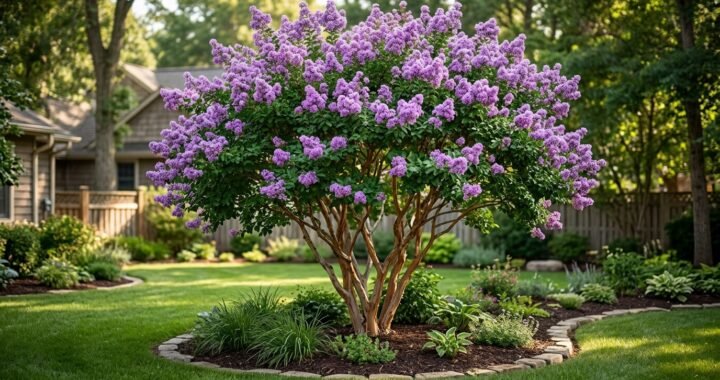
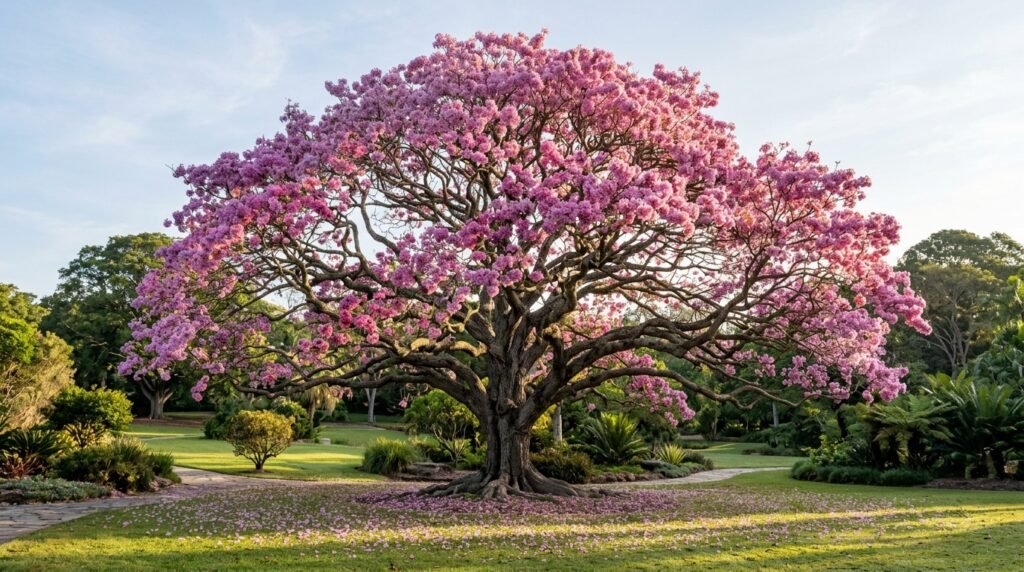
Tabebuia impetiginosa pink trumpet is a striking flowering tree known for masses of rose-pink, magenta, or purple-pink trumpet-shaped blooms that can cover nearly bare branches. The name Tabebuia impetiginosa remains common in gardening, nursery, and landscaping references, although the currently accepted botanical name is Handroanthus impetiginosus. Kew’s Plants of the World Online recognizes Handroanthus impetiginosus as the accepted species and lists Tabebuia impetiginosa as a synonym. The tree belongs to the Bignoniaceae family and is native from Central Mexico through parts of tropical South America. Its combination of seasonal leaf drop and heavy flowering creates a dramatic display because blooms may appear when little foliage is present. In warm landscapes, it can work as an ornamental garden, street, or accent tree where there is enough room for its crown and roots. Successful cultivation depends most on climate, sunlight, drainage, establishment watering, and early structural pruning. Established trees can tolerate dry conditions well, but cold climates are a major limitation.
Tabebuia Impetiginosa Is Now Accepted as Handroanthus Impetiginosus
Anyone researching tabebuia impetiginosa pink trumpet will quickly encounter two scientific names, and this can make plant identification seem more confusing than it is. Handroanthus impetiginosus is the currently accepted name used by Kew’s Plants of the World Online, while Tabebuia impetiginosa is listed as a synonym. The plant was historically classified within Tabebuia, which explains why nurseries, older gardening books, landscape documents, and many gardeners continue to use the older name. Other historical names also exist, including Tabebuia avellanedae. These name changes do not mean every plant sold as a pink trumpet tree is this species, however. Several related trees can carry similar common names, so the scientific name is useful when buying or identifying a plant. Handroanthus impetiginosus belongs to the Bignoniaceae family and the genus Handroanthus. For everyday gardening, using the older Tabebuia name is understandable, but using the accepted botanical name when ordering a tree can reduce confusion.
What the Pink Trumpet Tree Looks Like
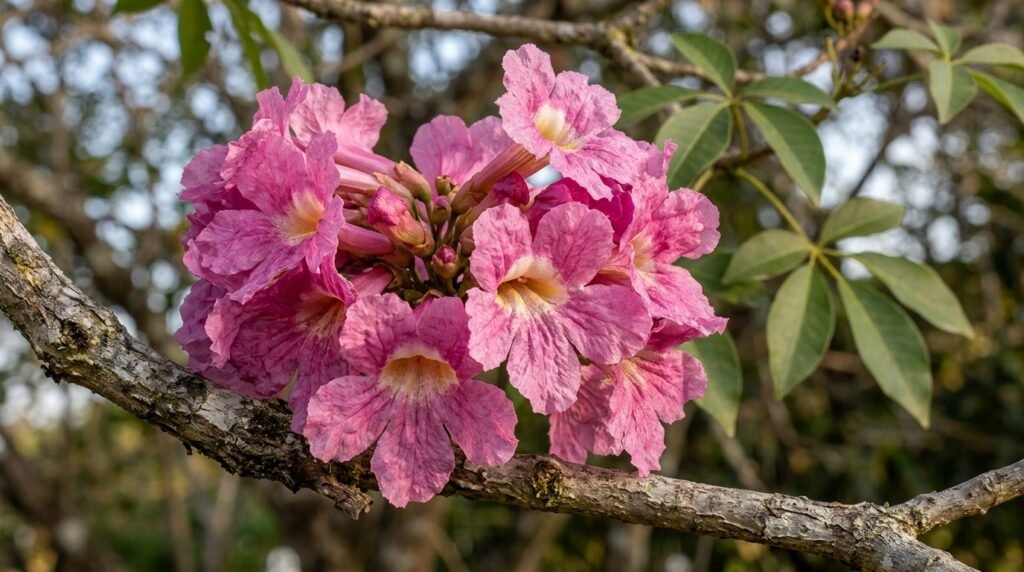
The flowers are the feature that makes tabebuia impetiginosa pink trumpet memorable, but its leaves, growth habit, bark, and fruit also help with identification. The species produces palmately compound leaves, meaning several leaflets spread from one point in a hand-like pattern. Kew records usually five leaflets, sometimes more, while botanical descriptions note ovate to elliptic forms. Flowers develop in terminal clusters and range from rose-pink and magenta to purple-pink or mauve. Their tubular, funnel-like shape creates the familiar trumpet appearance. Kew records corollas with a yellow throat that can later become purplish. After flowering, the tree can develop elongated dry capsules containing winged seeds. Growth varies considerably with climate and conditions. Botanical sources describe the species as capable of becoming a substantial tree in its native or favorable tropical environment, while landscape specimens grown in places such as Florida may remain much smaller. University of Florida guidance describes commonly cultivated specimens around 15 to 20 feet tall with an open canopy.
The Flower Display Is Most Dramatic on Nearly Bare Branches
One reason tabebuia impetiginosa pink trumpet creates such a strong landscape effect is the timing of flowering in relation to its leaves. The tree is deciduous or briefly deciduous, depending on climate, and can shed much of its foliage before flowering. University of Florida describes showy rose-pink to purple flowers appearing in late winter or early spring, while other botanical observations show flowering seasons shifting with local climate. In its native and cultivated ranges, flowering should therefore be understood as climate-dependent rather than tied to one universal calendar month. The visual effect remains similar: clusters of bright trumpet-shaped flowers can cover branches while foliage is sparse, allowing the color to dominate the crown. New foliage follows the flowering period. This seasonal rhythm makes the tree particularly valuable as an ornamental focal point, but gardeners should understand that temporary leaf loss is part of its normal cycle in suitable conditions. A briefly bare tree before flowering is not automatically a sign of disease or water stress.
Full Sun Produces the Best Landscape Performance
A sunny location is the safest choice for tabebuia impetiginosa pink trumpet. University of Florida lists full sun as the light requirement for the species, and Singapore’s National Parks Board also identifies full sun as its preferred light condition. Strong light supports normal growth and helps create conditions suitable for flowering. This does not mean a tree must receive sunlight every minute of the day, but a heavily shaded site beneath larger trees or beside tall structures is a poor choice if the goal is a healthy flowering specimen. Before planting, observe how sunlight moves across the site during the growing season. A space that looks sunny in winter may become shaded once surrounding trees leaf out. Also consider the tree’s future crown rather than the small nursery plant. A location surrounded closely by buildings can restrict both light and canopy development as the tree matures. In warm regions where the species is climatically suitable, an open lawn edge, broad garden bed, or other sunny landscape position generally provides better conditions than a cramped shaded corner.
Well-Drained Soil Matters More Than a Particular Soil Texture
The soil requirement for tabebuia impetiginosa pink trumpet is relatively flexible, but drainage deserves close attention. University of Florida lists clay, sand, and loam among tolerated soil textures and notes that the tree can grow in acidic or alkaline conditions when the soil is well drained. It also reports that trees respond especially well to rich soil. This flexibility is useful because gardeners do not need to create an unusually specialized soil mixture simply because the tree has tropical origins. Drainage, however, should not be ignored. A planting hole that remains waterlogged after rainfall can create a much different root environment from a free-draining site. Before planting, inspect the area after heavy rain and look for prolonged standing water. Avoid assuming that adding a small amount of good soil inside a poorly drained hole will solve a larger drainage problem. The surrounding soil still controls where roots eventually grow. Improving the site or selecting another location can be more effective than creating a small amended pocket in persistently wet ground.
Planting the Tree Correctly Gives Roots a Better Start
Planting tabebuia impetiginosa pink trumpet begins with selecting a location that can accommodate a tree rather than treating it like a temporary flowering shrub. Check mature clearance from buildings, overhead utilities, paved areas, and neighboring trees before digging. The root flare should remain near the finished soil level instead of being buried deeply beneath soil or mulch. Digging a broad planting area can make it easier for new roots to move into surrounding soil, while an unnecessarily deep hole can allow the root ball to settle. Once planted, water thoroughly to settle soil around the root zone. Mulch can help moderate soil moisture and temperature, but it should be kept away from direct contact with the trunk. Young trees may require support when unstable, and University of Florida specifically recommends training this species to a single trunk and staking during early development where needed. Planting is only the beginning; establishment watering and early structural care have a major influence on how the tree develops.
Young Trees Need Water Even Though Mature Trees Tolerate Drought
Established tabebuia impetiginosa pink trumpet trees are known for good drought tolerance, but that characteristic should not be applied blindly to newly planted trees. University of Florida rates established specimens as highly drought tolerant, while Singapore’s National Parks Board describes the species as having moderate water needs. These statements are not contradictory because water requirements change with establishment, climate, soil, and tree size. A recently transplanted tree has a limited root system and cannot explore the surrounding soil as effectively as an established specimen. During establishment, watering should keep the root zone adequately moist without leaving the tree in saturated ground. Frequency should respond to weather and soil rather than a rigid calendar. Hot, dry conditions can require more attention, while rainfall may reduce the need for irrigation. As roots spread into the surrounding soil, watering can generally become less frequent. Continually keeping an established drought-tolerant tree in wet soil is not a substitute for good care.
Climate Is the Biggest Limitation for Many Gardeners
The most important question before buying tabebuia impetiginosa pink trumpet is whether the local climate is warm enough. University of Florida places Tabebuia impetiginosa in USDA hardiness zones 9B through 11, making it much better suited to warm subtropical and tropical landscapes than regions with severe winter freezes. The University of North Florida also notes that the tree is near its northern limit around Jacksonville and suggests protected placement where cold becomes a concern. This is an important reminder that successful cultivation in one part of a state or country does not guarantee success farther north or at higher elevations. Local microclimates can also matter. A protected urban garden may remain warmer than an exposed rural site nearby. Gardeners near the edge of the suitable range should consider cold-air drainage, wind exposure, building protection, and historical winter lows before planting. A spectacular flowering tree is not a practical landscape choice if repeated cold injury prevents healthy long-term development.
Early Pruning Helps Build a Stronger Tree
Structural pruning is more important for tabebuia impetiginosa pink trumpet than simply trimming it for appearance. University of Florida notes that the tree benefits from training to a single trunk and reports that pruning is needed to develop strong structure. Young specimens may have sparse or irregular branching, and thoughtful early training can reduce structural problems as branches become heavier. The goal is not to shear the canopy into a formal shape. Instead, early pruning should encourage a sound trunk and well-positioned main branches while removing obvious competing leaders, damaged growth, or poorly arranged branches when appropriate. Large corrective cuts become harder on mature trees, so structural decisions are generally easier while the tree is young. Over-pruning should still be avoided because leaves supply energy for growth. Trees planted beside roads, driveways, or walkways may also require future clearance pruning as the canopy develops. If a mature tree has large weak unions, storm damage, or branches over structures, professional arboricultural assessment is safer than aggressive DIY cutting.
The Tree Can Work as an Accent, Street, or Garden Tree
The dramatic flowers make tabebuia impetiginosa pink trumpet a natural candidate for ornamental planting. Its best position depends on the available space and desired effect. University of Florida suggests using it where a small flowering tree fits and notes that the canopy can remain relatively open. This lighter canopy may allow more sunlight to reach plants or turf below than a dense shade tree would. In a home landscape, the tree can work near a broad lawn, in a mixed tree-and-shrub border, or as a seasonal flowering accent visible from windows and outdoor living areas. Street planting is possible where climate, soil volume, clearances, and local planting rules are suitable, although structural pruning should be planned early. The tree should not be squeezed into a tiny planting space simply because young nursery specimens look compact. Root space and crown clearance become more important with age. Its strongest landscape value comes from giving the flowering crown enough visual room to be appreciated rather than hiding it between larger trees.
Flowers Attract Attention but Bloom Timing Varies by Climate
Searches for tabebuia impetiginosa pink trumpet often focus on when the tree flowers, yet a single month cannot accurately describe its behavior everywhere it grows. University of Florida describes flowering in late winter or early spring. A botanical guide from Taichung describes spring flowering, while records from India show flowering and fruiting during roughly January through March in observed cultivated populations. In Argentina, seasonal timing differs again because the Southern Hemisphere has opposite seasons from North America. These variations are normal. Temperature, rainfall patterns, dry periods, latitude, elevation, and local weather can influence flowering. The more reliable expectation is that the species often loses leaves or becomes sparsely foliated around its flowering period, then produces conspicuous clusters of pink to purple-pink trumpet-shaped blooms. Gardeners should therefore use local botanical gardens, extension services, and mature neighborhood specimens to estimate bloom timing in their own climate rather than applying a flowering calendar from another region.
Pink Trumpet Tree Flowers Are Easy to Recognize
The flowers of tabebuia impetiginosa pink trumpet provide one of the best identification clues when combined with leaf and fruit characteristics. Kew describes the flowers as magenta or orange-pink, with a throat that begins yellow and can become purplish. They form terminal clusters or panicles at the ends of branches. Individual flowers have the tubular, funnel-shaped form responsible for the “trumpet tree” common name. Color can appear different depending on the individual tree, lighting, climate, and stage of bloom, so identification should not rely on a precise shade of pink alone. The palmately compound leaves are another useful clue, typically containing five leaflets. Long, dry seed capsules may follow flowering. The combination of pink-purple trumpet blooms, hand-like compound foliage, seasonal leaf drop, and elongated fruit is much more useful than flower color by itself. This matters because several related ornamental trees are called pink trumpet trees, and common names can easily cause confusion between species.
Propagation Is Possible From Seed and Vegetative Material
Gardeners interested in propagating tabebuia impetiginosa pink trumpet have several possible methods. University of Florida lists seed, cuttings, and layering as propagation methods for Tabebuia impetiginosa. Seeds develop inside elongated capsules and are adapted for dispersal with wing-like structures. Seed propagation can be useful when growing multiple plants, although seedlings should not automatically be expected to reproduce every feature of a particular ornamental parent exactly. Vegetative methods can be useful when maintaining selected characteristics matters. Propagation success depends on fresh, viable material and suitable growing conditions. Young seedlings need protection from severe environmental stress while establishing. Anyone collecting seed should first confirm the tree’s identity because several trumpet-tree species can grow in the same warm landscapes. Local regulations and property ownership should also be respected when collecting plant material. For most homeowners who want one reliable landscape specimen, purchasing a correctly identified nursery tree may be simpler than raising a tree from seed, especially where species confusion is common.
Serious Pest and Disease Problems Are Not Usually the Main Concern
One advantage reported for tabebuia impetiginosa pink trumpet is that major pest and disease issues are not commonly emphasized in landscape references. University of Florida states that no pests or diseases are of major concern and rates the species as generally free of serious pest problems. That does not mean an individual tree can never suffer damage. Environmental stress, root problems, mechanical injury, poor drainage, cold damage, or local pests can still affect tree health. Browning leaves, dieback, weak growth, or poor flowering should therefore be diagnosed rather than automatically treated with pesticide. Check soil moisture, recent weather, planting depth, trunk injury, and root-zone conditions first. A young tree that declines after planting may be struggling with establishment rather than infection. Likewise, damage after an unusual freeze may resemble disease. If symptoms continue spreading or major branches begin dying, a qualified arborist or local plant diagnostic service can help determine the cause before treatment. Unnecessary chemical applications can waste money and fail to correct the actual problem.
Poor Flowering Can Have More Than One Cause
A healthy tabebuia impetiginosa pink trumpet may not flower heavily every season, especially when young or grown under marginal conditions. Light is one factor worth checking because the species performs best in full sun. Climate also matters; a tree growing near its cold limit can face stress that affects overall performance. Age, recent pruning, weather, water availability, and general tree vigor may influence flowering as well. Avoid trying to force blooms with excessive fertilizer without understanding the soil and tree condition. Heavy nitrogen feeding can encourage leafy growth in many landscape plants and is not a substitute for correct light and climate. Another common mistake is comparing a young garden tree with photographs of mature specimens in ideal tropical or subtropical conditions. Trees need time to establish their root systems and develop a flowering canopy. University of Florida notes that plants can flower at an early age, but actual performance still varies. Start by confirming that the tree receives strong sunlight, has well-drained soil, and is otherwise healthy before treating reduced flowering as a specific problem.
Common Mistakes to Avoid With Pink Trumpet Trees
Several avoidable mistakes can reduce the performance of tabebuia impetiginosa pink trumpet. Planting it in a climate that experiences damaging freezes is one of the biggest because no amount of fertilizer can compensate for an unsuitable winter climate. Deep shade is another poor choice for a species that prefers full sun. Persistently waterlogged soil can create unnecessary root stress even though the tree tolerates several soil textures. Newly planted trees should not be treated as fully drought tolerant before their roots establish. At the opposite extreme, an established tree should not be kept constantly saturated simply because frequent watering seems helpful. Another mistake is ignoring structure during the early years and then attempting major corrective pruning once large branches have developed. Planting too close to buildings, overhead utilities, or other trees can also create future conflicts. Finally, avoid identifying a tree by the common name “pink trumpet tree” alone. Several species share similar names. Confirming the scientific name helps ensure that climate, size, care, and identification advice actually applies to the plant being grown.
Tabebuia Impetiginosa Has a Broad Native Range
Understanding the natural range of tabebuia impetiginosa pink trumpet helps explain why descriptions of its size, flowering season, and growth can vary. Kew records the accepted Handroanthus impetiginosus as native from central Mexico through parts of Central America and much of tropical South America, including countries and regions such as Bolivia, Brazil, Colombia, Costa Rica, Guatemala, Honduras, Nicaragua, Panama, Paraguay, Peru, Suriname, Venezuela, and northwestern Argentina. Kew describes it primarily as a tree of tropical environments, although populations occur across varied landscapes and elevations. A species spread across such a broad geographic area will not behave identically in every location. Cultivated trees outside the native range add even more variation because rainfall, temperature, soils, and seasons may differ from their natural habitats. This is why local growing experience should be combined with botanical information. General species guidance identifies the tree’s needs, while local observations reveal how those needs translate into a specific garden climate.
FAQs
Is tabebuia impetiginosa pink trumpet the correct botanical name?
Tabebuia impetiginosa is a widely used botanical synonym, but Kew currently accepts Handroanthus impetiginosus as the scientific name. The older name remains common in horticulture, nursery listings, landscape documents, and gardening references, so both names may refer to the same species.
How tall does a pink trumpet tree grow?
Size depends strongly on climate and growing conditions. University of Florida describes cultivated Tabebuia impetiginosa around 15 to 20 feet tall, while botanical records show that the species can become much larger under favorable tropical conditions, with some descriptions reaching about 30 meters. Landscape expectations should therefore be based on local conditions rather than the species’ maximum recorded size.
Does the pink trumpet tree lose its leaves?
Yes. The species is deciduous or briefly deciduous depending on climate. It often loses much of its foliage around the flowering period, which allows the pink-purple blossoms to stand out strongly against bare or nearly bare branches. New foliage develops as the seasonal cycle continues.
Does a pink trumpet tree need full sun?
Full sun is the preferred condition. Both University of Florida and Singapore’s National Parks Board list full sun for this species. A bright, open site is generally more suitable than deep shade, especially when strong flowering is an important landscape goal.
Is the pink trumpet tree drought tolerant?
Established trees have strong drought tolerance according to University of Florida. Newly planted trees still need adequate water while roots become established. Good drainage remains important, and drought tolerance should not be interpreted as a reason to neglect a recently transplanted specimen.
When does the pink trumpet tree bloom?
Bloom time varies with climate and location. University of Florida describes flowering in late winter or early spring, while records from other countries show different calendar months. The tree often flowers around a period of leaf drop, producing dense clusters of pink, magenta, or purple-pink trumpet-shaped flowers on relatively bare branches.
Conclusion
Tabebuia impetiginosa pink trumpet is valued for a flowering display that can transform a nearly bare canopy into a mass of rose-pink, magenta, or purple-pink trumpet-shaped blooms. Although the older Tabebuia name remains widely recognized, Handroanthus impetiginosus is the currently accepted botanical name. The species performs best where winters are mild, sunlight is strong, and soil drains freely. Young trees benefit from sensible establishment watering and early structural training, while established specimens can tolerate dry conditions well. Gardeners near the cold edge of its growing range should pay particular attention to winter temperatures and protected planting positions. Flowering dates vary by climate, so local mature trees provide a better seasonal reference than a calendar from another region. Give the tree enough room for its future crown, avoid deep shade and persistently wet soil, and confirm its botanical identity before applying species-specific care. In a suitable warm landscape, tabebuia impetiginosa pink trumpet can provide one of the most distinctive seasonal flower displays among ornamental trees.