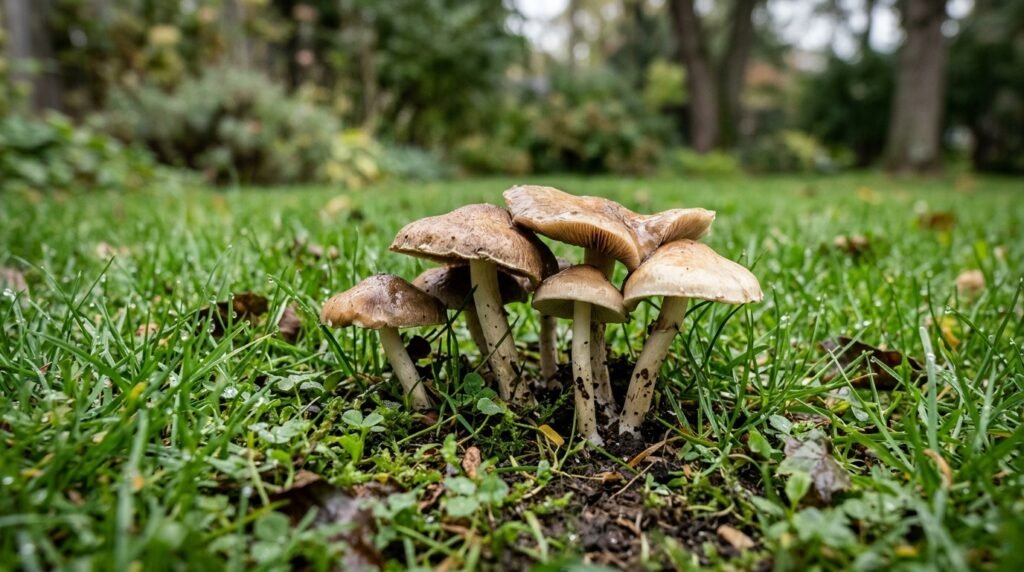
Toadstools in grass are usually a sign that fungi are growing in the soil beneath your lawn. They often appear suddenly after rain, during damp weather, or in areas with poor drainage. In most cases, they do not mean your grass is diseased or dying. The fungi are often breaking down old roots, buried wood, dead leaves, and other organic material. However, some lawn mushrooms can be poisonous, so it is important to keep children and pets from eating them. The best way to manage them depends on why they are growing and whether they create a safety concern. This article explains what causes lawn toadstools, how to recognize common growth patterns, whether they damage grass, and how to remove them safely.
What Are Toadstools in Grass?
Toadstools in grass are the visible, above-ground parts of fungi living in the soil or decaying material beneath your lawn. The familiar cap and stem are not the entire organism. Most of the fungus consists of a network of fine threads called mycelium, which spreads through soil, dead roots, wood, and other food sources. When conditions become suitable, the fungus produces mushrooms or toadstools above the surface. These structures release spores that can spread through wind, water, animals, and other means. The visible mushrooms may last only a short time, while the underground fungus can remain in place for years. Different fungi produce different shapes, colors, sizes, and growth patterns. Some appear as single mushrooms, while others grow in clusters or curved lines. Their appearance alone does not reliably show whether they are safe to touch or eat. Most lawn fungi help break down organic matter and recycle nutrients, but some species can harm people or pets if swallowed.
Why Do Toadstools Suddenly Appear in a Lawn?
The most common reason is a combination of moisture and available organic material. Fungi often live underground without producing visible mushrooms. After rain or heavy watering, damp conditions can encourage them to form their reproductive structures. The mushrooms may then appear across the lawn almost overnight. Their food source may include old tree roots, buried branches, dead leaves, grass clippings, thatch, and decaying wood left from earlier landscaping work. A lawn can therefore develop mushrooms even when it looks healthy and receives regular care. Some fungi also form relationships with living plant roots. These relationships can help plants take up water and nutrients, although the visible mushroom itself is simply the fruiting structure. Toadstools in grass are especially common in places where moisture remains for a long time. Shaded corners, low spots, areas beneath trees, and lawns with poor drainage may provide suitable conditions. Their sudden appearance does not necessarily mean a new fungus has entered the garden. The organism may have been present below the surface for a long time.
Common Conditions That Encourage Toadstool Growth
Several lawn conditions can make mushroom growth more likely, and they often occur together. Heavy rain supplies moisture, while buried organic matter provides food. Poor drainage can keep the soil wet for longer than necessary. Thick thatch may also hold moisture and contain dead plant material that fungi can break down. Shaded areas often dry more slowly than exposed parts of the garden. This can explain why mushrooms appear beneath trees or beside fences but not across the entire lawn. Overwatering can create similar conditions, especially when sprinklers run during rainy periods. Recent tree removal may also leave roots or a stump underground. As this material decays, fungi can use it as a food source. Construction debris buried during earlier building work may have the same effect. These conditions do not always indicate poor lawn care. Natural soil processes can produce mushrooms in well-maintained gardens too. If toadstools in grass appear repeatedly in one location, look for a likely source of moisture or buried organic material before changing your entire lawn-care routine.
Do Toadstools Mean Your Grass Is Diseased?
No. The presence of mushrooms does not automatically mean the grass has a disease. Many lawn fungi feed on dead organic matter rather than living grass. They help break down material that would otherwise remain in the soil. Some fungi also live alongside plant roots without causing visible harm. In these cases, the mushrooms are a sign of natural fungal activity, not a lawn infection. However, certain fungi can be associated with fairy rings or other turf problems. You may notice dark green grass, poor growth, or patches of dead turf around a circular pattern. A dense fungal network can sometimes interfere with water movement through the soil. The grass may then struggle during dry weather. It is useful to examine the whole lawn rather than judging its health by the mushrooms alone. Look for changes in grass color, thinning, dead patches, and unusual growth patterns. If the lawn remains green and healthy, occasional mushrooms may need no treatment beyond removal where children or pets could reach them.
How to Recognize Different Toadstool Growth Patterns
Toadstools can appear in several patterns, and these patterns may offer clues about the fungi beneath the surface. Random individual mushrooms are common where fungi feed on scattered pieces of buried organic matter. Clusters may appear close to old roots, wood, or other concentrated food sources. Curved lines and circles can suggest a fairy ring, which forms as certain fungi grow outward through the soil. Some lawns develop only a darker band of grass, while others show mushrooms along part of the ring. A few may also develop brown or dead areas. These patterns are useful observations, but they do not identify a mushroom species or establish whether it is poisonous. Do not use color, smell, cap shape, or growth location as a safety test. Many different species can look similar, and appearance can change as a mushroom matures. If identification matters, ask a qualified local mushroom expert or appropriate extension service. Treat unknown mushrooms as unsafe until a reliable expert has identified them.
What Are Fairy Rings in Grass?
Fairy rings are circular, semicircular, or arc-shaped patterns caused by fungi growing outward through the soil. They may appear as dark green bands, mushrooms, brown grass, or a combination of these signs. The fungi often feed on buried organic material, such as old roots, stumps, and pieces of wood. As the material breaks down, nutrients can become available to the grass. This may create a darker green band where the grass grows more strongly. In other cases, dense fungal growth can affect water movement through the soil. The grass may become stressed or die in parts of the ring, particularly during dry weather. Mushrooms may appear along the ring after rain, but not every fairy ring produces visible mushrooms. Some rings show only changes in grass color or growth. Their size and appearance can vary, and they may become more noticeable during suitable weather. Fairy rings can be difficult to manage because much of the fungus remains underground. Removing the visible mushrooms improves appearance and reduces access for children and pets, but it does not remove the underground organism.
Are Toadstools in Grass Poisonous?
Some are poisonous, and an unknown lawn mushroom should never be treated as edible. Many species grow in lawns, and some poisonous varieties can resemble harmless ones. A photograph or a quick description may not provide enough information for safe identification. Do not taste a mushroom to test it, and do not rely on folk methods such as checking its smell or color. These methods cannot reliably determine whether a mushroom is safe. The safest approach is to prevent children and pets from eating any unknown mushrooms. If a child or animal may have swallowed one, seek urgent advice from a local poison service, medical professional, or veterinarian. Keep a sample or photograph if it can be collected safely, but do not delay getting help. Avoid assuming that a mushroom is harmless because birds or insects have been near it. Different animals respond differently to substances, and their behavior is not a reliable safety guide. Toadstools in grass should be removed from accessible areas when there is a risk of accidental eating.
Are Lawn Toadstools Harmful to Dogs and Cats?
Some lawn mushrooms can poison pets, so it is safest to stop dogs and cats from chewing or eating unknown growths. Dogs may investigate mushrooms while sniffing or exploring the garden. Cats can also come into contact with them, although their behavior varies. The risk depends on the mushroom species and the amount swallowed. Because many species are difficult to identify, do not wait for symptoms before seeking advice if you suspect your pet has eaten one. Contact a veterinarian promptly and describe what happened. If possible, take a clear photograph of the mushroom and note where it was growing. Do not try to make your pet vomit unless a veterinary professional tells you to do so. To reduce risk, inspect the lawn regularly during wet weather and remove visible mushrooms before allowing pets into the area. Dispose of them in a closed waste container that animals cannot access. If mushrooms keep appearing, repeat the inspection because new fruiting bodies may develop after further rain.
How to Remove Toadstools from Grass Safely
For a small number of mushrooms, hand removal is usually a simple way to clear the lawn surface. Wear gloves, grip each mushroom near its base, and lift it carefully. Avoid crushing it with bare hands or leaving removed mushrooms where children or pets can reach them. Place the mushrooms in a sealed bag or suitable waste container and follow local waste-disposal guidance. Wash your hands after handling them, even if you wore gloves. If many mushrooms cover the lawn, a rake may help collect them without touching each one. Mowing can also remove visible mushrooms, but it may scatter pieces and spores around the area. Avoid mowing over mushrooms where children or pets could later pick up the remains. Removing the visible growth does not kill the fungus beneath the soil. New mushrooms may appear when moisture and other conditions remain suitable. For this reason, removal is mainly a way to reduce exposure and improve the lawn’s appearance. It is not a permanent cure for the underlying fungal growth.
How to Reduce Toadstools by Improving Lawn Conditions
You may reduce repeated mushroom growth by making the lawn less suitable for visible fruiting. Start by checking how water moves through the garden. If puddles remain for long periods, consider whether compacted soil, low spots, or blocked drainage are contributing to the problem. Adjust irrigation so the lawn does not receive unnecessary water, especially after rain. Remove heavy accumulations of dead leaves and excess thatch where appropriate. If a tree stump or large buried piece of wood is clearly responsible, removing it may reduce the food source over time. However, digging into an established lawn can damage roots and disturb the soil, so consider the scale of the work first. Aeration may help compacted soil in suitable lawns, but it should be done at an appropriate time for the grass type and local conditions. Avoid adding extra fertilizer simply to make mushrooms disappear. Fertilizer does not remove the underground fungus, and unnecessary applications can create other lawn problems. The goal is to improve lawn conditions, not to sterilize the soil.
Does Removing Mushrooms Stop Them From Coming Back?
No. Removing the visible mushrooms does not usually remove the fungus that produces them. The main body of the fungus is often below the soil surface or inside decaying organic material. Picking a mushroom removes its fruiting structure, but the underground network may remain alive. If the weather becomes damp again, it may produce more mushrooms. This is why repeated removal may be necessary during rainy periods. It is also why a lawn can develop mushrooms in the same area year after year. Removing a buried stump or other food source may help in some situations, but it does not guarantee immediate results. Some fungi can remain in the soil for a long time. If the mushrooms are not causing a safety problem or damaging the turf, leaving them alone may be reasonable. If they are within a play area or a place where pets explore, regular removal is a practical precaution.
Will Fungicide Get Rid of Toadstools in Grass?
Fungicide is usually not a useful solution for ordinary mushrooms growing in a lawn. The visible mushroom is only a small part of the fungus, while most of its network remains underground or within buried material. Spraying the mushroom does not reliably reach or remove that underground growth. Extension guidance commonly recommends removing visible mushrooms when necessary and addressing suitable lawn conditions instead. Fairy rings can be particularly difficult to control, and treatment options depend on the type of ring and the condition of the turf. Do not apply a lawn fungicide simply because mushrooms have appeared. First check whether the product is approved for the intended use in your location and whether its label covers the actual problem. Follow all label instructions and keep people and pets away as directed. If the lawn has expanding dead areas or persistent damage, a local lawn-care specialist or plant diagnostic service may help identify the cause. Correct identification matters because not every mushroom problem is a turf disease.
When Should You Be Concerned About Mushrooms in Your Lawn?
Occasional mushrooms in an otherwise healthy lawn are usually not a reason to panic. More attention is needed when children or pets can reach unknown mushrooms, when the lawn develops large dead patches, or when a circular pattern continues to expand. A sudden increase after heavy rain may simply reflect favorable growing conditions. However, repeated growth in one area can point to buried wood, old roots, or a persistent moisture problem. Check whether the ground stays wet, whether water pools after irrigation, and whether grass around the mushrooms is changing color. If a tree near the lawn is declining or mushrooms grow around its base, seek advice from a qualified tree-care professional. Some fungi associated with woody plants can be linked to root or trunk decay. Do not assume that every mushroom near a tree means the tree is unsafe, but investigate signs such as poor growth, leaning, damaged roots, or decaying wood. For unusual lawn damage, a local horticulture or plant diagnostic service can help assess the symptoms.
Common Mistakes When Dealing With Lawn Toadstools
One common mistake is assuming every mushroom is poisonous or that every mushroom is harmless. Neither assumption is safe. Another is trying to identify a species from a single feature, such as its color or size. Reliable identification requires more than a quick visual guess. Some people spray fungicide without understanding that the visible mushroom is only the fruiting part of a larger organism. Others water the lawn more heavily in an attempt to improve its appearance, even when excess moisture is helping mushrooms develop. Applying extra fertilizer without checking the lawn’s needs can also cause problems. Avoid leaving removed mushrooms on the grass, where children or pets may still reach them. Do not place unknown mushrooms in a compost pile if people or animals may come into contact with the material. Finally, do not dig up large sections of turf without first checking whether buried organic matter or drainage is actually the cause. A careful inspection and simple removal are often more sensible than an aggressive treatment.
Can You Leave Toadstools in Grass?
Yes, in many cases you can leave them if they are not creating a safety concern or damaging the lawn. Fungi play a useful role in breaking down dead plant material and returning nutrients to the soil. Some also form beneficial relationships with plant roots. Removing every mushroom is not necessary for a healthy lawn, and it may not be practical during periods of wet weather. However, leaving unknown mushrooms is not a good choice in areas used by young children or pets that might eat them. In those locations, remove visible growth before allowing access. You can also inspect the lawn more often after rainfall. If mushrooms appear in a quiet part of the garden and nobody is likely to touch or eat them, there may be no need to intervene. The decision should depend on safety, lawn condition, and the location of the growth rather than appearance alone.
How Long Do Toadstools Stay in Grass?
The visible mushrooms often last for a short period, but their lifespan varies by species and weather. Some dry out or collapse quickly when conditions become hot and dry. Others may remain visible for several days or longer when the weather stays damp. Rain can also encourage new mushrooms to appear after earlier ones have disappeared. The underground fungus may survive much longer than the visible growth. It can remain in soil or decaying wood and produce new fruiting bodies when conditions are favorable. This explains why the same lawn may show mushrooms in different seasons or after repeated periods of rain. There is no single waiting period that applies to every lawn. If the mushrooms are in a safe location and the grass is healthy, allowing the visible growth to disappear naturally is often reasonable. If children or pets use the area, remove the mushrooms rather than waiting for them to dry out.
How to Prevent Recurring Mushroom Problems
You cannot always prevent fungi from living in lawn soil, but you can reduce some conditions that encourage visible mushroom growth. Avoid watering when the soil is already wet, and check that sprinklers are not running unnecessarily. Clear fallen leaves and other dead plant material before they build up. Remove old stumps and large roots when preparing a new lawn, where practical. If the soil is compacted, suitable aeration may improve water movement and support healthier grass growth. Keep mowing and lawn maintenance appropriate for the grass type and season. Do not cut grass too short in an attempt to expose and dry out mushrooms. If a low area repeatedly holds water, consider whether grading or drainage improvements are needed. Large drainage changes may require professional advice because they can affect nearby gardens and structures. These steps can make the lawn easier to maintain, but they cannot guarantee that mushrooms will never return. The fungus may already be established below ground, and natural rainfall can still create favorable conditions.
Frequently Asked Questions
Are toadstools in grass a sign of too much water?
They often appear after heavy rain or overwatering because damp conditions encourage fungi to produce visible mushrooms. However, moisture is only part of the explanation. The fungus also needs a suitable food source, such as decaying roots, wood, leaves, or thatch. Their presence does not prove that the lawn has a drainage problem.
Should I remove toadstools from my lawn every day?
Remove visible mushrooms whenever children or pets could reach and eat them. During wet weather, new growth may appear, so regular checks can be useful. If the mushrooms are in an inaccessible area and the lawn is healthy, removal may not be necessary for turf health.
Can toadstools in grass damage the lawn?
Most lawn mushrooms do not directly harm grass. Many fungi break down dead organic material and recycle nutrients. Some fungi can cause fairy rings, which may produce dark green bands or areas of stressed and dead grass. Check the surrounding turf for changes rather than assuming every mushroom is damaging.
Can I use vinegar or washing-up liquid to kill lawn mushrooms?
Household mixtures are not reliable ways to remove the underground fungus. They may also harm grass or affect soil conditions if used carelessly. The visible mushroom is only the fruiting body, so treating it does not necessarily affect the larger fungal network. Remove mushrooms safely and address excess moisture where possible.
Will grass grow normally after mushrooms disappear?
In many cases, yes. If the mushrooms were feeding on dead organic material and the turf was not damaged, the grass may continue growing normally. If you see bare patches, brown rings, or thinning, investigate the soil and fungal pattern. Some fairy ring conditions can affect grass health, especially during dry periods.
Are small white toadstools in grass safe?
Not necessarily. Small white mushrooms can belong to different species, and some may be poisonous. Size and color are not reliable ways to judge whether a mushroom is safe. Keep children and pets away from unknown mushrooms, and never eat them without reliable expert identification.
Conclusion
Toadstools in grass usually appear when moisture and decaying organic material create suitable conditions for fungi. Most lawn mushrooms are not a sign of serious grass disease, and many play a useful role in breaking down dead plant matter. However, unknown mushrooms should never be eaten because some species are poisonous to people and pets. Remove visible growth from play areas, inspect the lawn after rain, and look for problems such as poor drainage, buried wood, or fairy rings if mushrooms keep returning. Fungicides rarely solve ordinary lawn mushroom problems because the main fungal network remains underground. A healthy approach is to manage moisture, clear excess dead material, and protect children and pets rather than trying to eliminate every fungus from the soil.