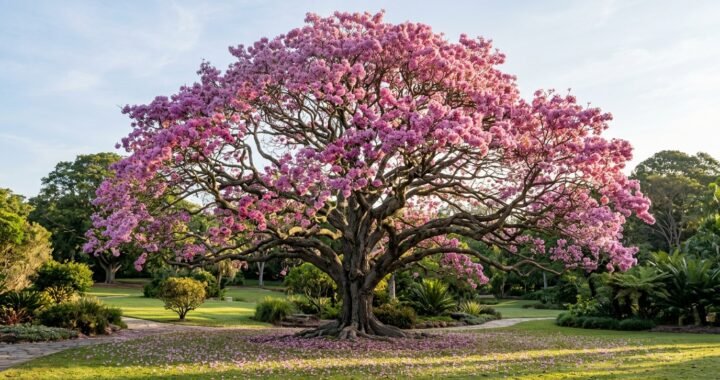
Zuni crape myrtle is a compact hybrid crape myrtle known for medium lavender flowers, attractive exfoliating bark, red-orange fall color, and good resistance to powdery mildew. The U.S. National Arboretum introduced ‘Zuni’ in 1986 after developing it through its Lagerstroemia breeding program. It has a rounded, semi-dwarf, multi-stemmed habit and is a useful choice where a full-size crape myrtle would become too large.
The U.S. National Arboretum lists ‘Zuni’ at roughly 8 to 10 feet tall and describes it as a dense shrub. Its flowers appear during summer, while its bark and fall foliage extend its ornamental value beyond the main flowering period. The original cultivar record notes mass flowering from mid-July into late September under the conditions in which it was evaluated. Exact bloom timing in a home landscape will vary with climate, weather, sunlight, and plant health.
For gardeners, the main decisions are straightforward: give the plant enough sun, allow room for its mature form, establish it with sensible watering, avoid unnecessary severe pruning, and watch local climate conditions. Understanding its natural size before planting is especially important because ‘Zuni’ is compact compared with large crape myrtles, but it is not a miniature shrub.
What Is Zuni Crape Myrtle?
Zuni crape myrtle is a named hybrid cultivar in the genus Lagerstroemia. The U.S. National Arboretum records it as Lagerstroemia ×egolfii ‘Zuni’. Its breeding background includes Lagerstroemia indica and L. fauriei ancestry. The Arboretum’s cultivar record states that it originated in 1972, was selected in 1977, and was introduced in 1986.
That background matters because the National Arboretum’s crape myrtle breeding work produced cultivars selected for ornamental qualities and improved disease resistance. ‘Zuni’ is described by the Arboretum as mildew resistant, while North Carolina State Extension also identifies it as a mildew-resistant selection.
Its overall character sits between tiny landscape crape myrtles and much larger tree-form cultivars. It naturally develops as a rounded, multi-stemmed shrub. With thoughtful training, it can have a more defined structural form, but gardeners should work with its natural habit rather than repeatedly forcing it into an unnaturally small shape.
How Big Does Zuni Crape Myrtle Get?
The U.S. National Arboretum’s current crape myrtle reference poster lists Zuni crape myrtle at about 8 to 10 feet tall. It classifies the plant as a dense shrub rather than a large tree.
This size makes ‘Zuni’ particularly useful in residential landscapes. It can provide substantial summer color without automatically occupying the space required by crape myrtles that mature at 15, 20, or more feet. Still, “semi-dwarf” should not be confused with tiny. An 8-to-10-foot shrub needs meaningful room.
Mature dimensions can also vary with climate, soil, care, pruning, and growing conditions. Nursery labels may therefore show somewhat different ranges. Use the official cultivar description as a useful reference, then allow additional practical clearance around buildings, paths, other plants, and utilities.
Planning for mature size reduces future pruning. A plant placed where only a four-foot shrub fits will eventually create a maintenance problem, even if it looked perfectly proportioned when purchased.
Lavender Flowers Are Its Main Summer Feature
The flowers are one of the easiest ways to recognize Zuni crape myrtle. The National Arboretum describes them as medium lavender. They form in clusters at the ends of growing shoots and can create a strong display when the plant is healthy and receiving suitable light.
The original cultivar description recorded mass blooming from mid-July through late September. That should be understood as a cultivar observation, not a guaranteed flowering calendar for every garden. A warmer climate may produce a different schedule from a cooler location. Seasonal temperatures, sunlight, pruning, and plant establishment can also influence flowering.
Avoid choosing a planting location based only on flower photographs. Think about how lavender will interact with nearby colors. It can work especially well beside restrained greens, warm stone, brick, pale siding, and other plants with softer flower colors.
After flowering ends, the plant still contributes through foliage, branching, and bark, which is an important advantage over shrubs valued only for a short flower display.
The Bark Adds Interest After Flowering
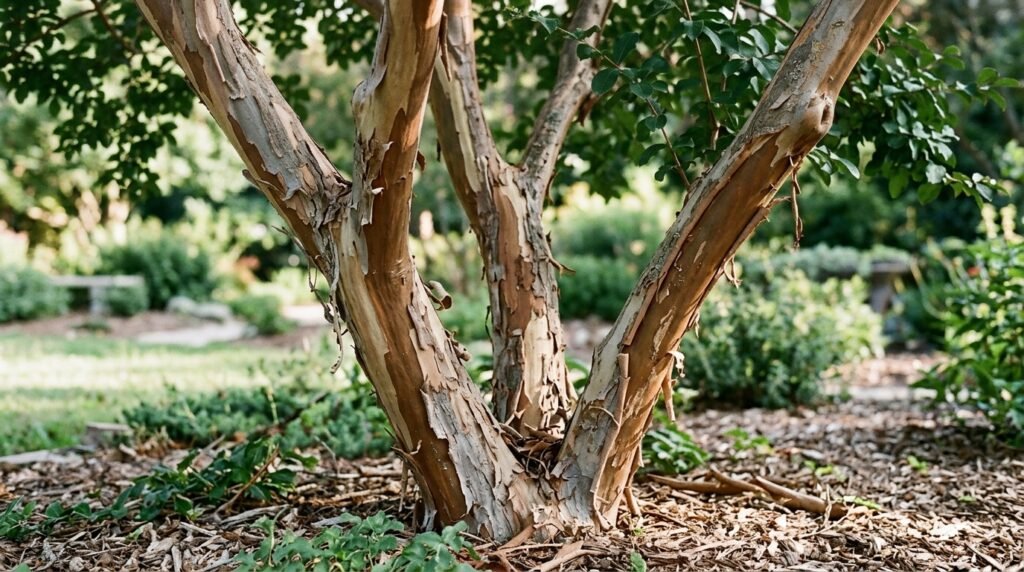
Flowers receive most of the attention, but mature crape myrtles can also develop attractive bark. The cultivar record for ‘Zuni’ describes exfoliating branches and trunks that show gray and later light brown-gray coloring. The National Arboretum’s current poster summarizes the bark color as light brown-gray.
Exfoliating bark means older outer bark naturally sheds or peels to reveal changing surfaces underneath. This is an ornamental characteristic, not automatically a sign that the plant is unhealthy.
That feature becomes easier to appreciate if the lower structure is not buried behind dense plants. A Zuni crape myrtle placed where its trunks remain visible can provide more winter interest after its leaves drop.
However, do not strip bark manually simply because it appears loose. Natural exfoliation should happen on its own. Likewise, avoid damaging trunks with string trimmers, mowers, or landscape equipment. Bark beauty depends on maintaining healthy stems, not treating the trunk as another decorative surface that needs regular intervention.
Fall Color Gives the Plant Another Season
Zuni crape myrtle does not stop contributing when summer flowers fade. The National Arboretum describes its fall leaves as orange-red to dark red. North Carolina State Extension similarly notes orange-red to red autumn foliage.
Actual fall color is influenced by weather and growing conditions, so a particular shade should not be guaranteed. Still, this seasonal change makes the cultivar useful in landscapes designed for more than summer bloom.
Consider the background when deciding where to plant it. Red-orange foliage may stand out strongly against evergreen shrubs, pale walls, or neutral fencing. The combination of summer lavender flowers, fall foliage, and exfoliating bark gives the plant several distinct ornamental periods.
This is also why aggressive pruning can reduce more than plant size. Poor cuts can damage the natural branching structure that carries the plant’s winter appearance. Allowing the shrub to develop a well-spaced framework generally produces a more attractive year-round specimen than repeatedly cutting the canopy back to the same short stubs.
Choose a Sunny Planting Location
Crape myrtles generally perform and flower best in strong sunlight. For Zuni crape myrtle, a sunny position also helps the plant develop the dense growth and flowering that make it valuable in a landscape.
Site selection should involve more than finding the brightest part of the yard. Look upward for utility lines and tree branches. Look outward for walls, paths, driveways, and neighboring plants. Then consider what the shrub may look like after reaching its mature dimensions.
Good air movement is useful too. Do not squeeze the plant into a narrow gap between dense shrubs simply because it fits there while young.
In very hot landscapes, local conditions can affect how plants respond to heat and reflected sunlight. A site surrounded by pavement and masonry behaves differently from an open lawn. Local extension guidance can help where climate conditions are unusually hot, cold, humid, or dry.
The right location reduces future work because less corrective pruning and transplanting will be necessary.
Soil Drainage Matters More Than Constant Feeding
A healthy root zone needs suitable drainage. Crape myrtles can adapt to a range of soils, but repeatedly saturated soil can create root problems. Before planting Zuni crape myrtle, observe what happens to water after heavy rain. A location that remains waterlogged needs attention before another shrub is added.
Do not automatically improve every planting hole with large amounts of rich amendment. A newly planted shrub needs roots to expand into the surrounding soil, not remain in a dramatically different pocket. Follow locally appropriate planting guidance for the site’s soil conditions.
Fertilizer should also have a purpose. Excessive nitrogen can encourage leafy growth without necessarily producing the balanced plant a gardener wants. If a mature landscape plant appears healthy, grows normally, and flowers well, routine heavy feeding may offer little benefit.
Where soil fertility or pH is genuinely uncertain, a soil test is more informative than guessing. Local extension services can provide recommendations suited to regional soils and growing conditions.
Plant at the Correct Depth
Poor planting depth can undermine an otherwise good site. The top of the root system should not disappear beneath a deep layer of soil or mulch. Before planting Zuni crape myrtle, locate the root flare or upper structural roots rather than assuming the soil level in the nursery container is automatically correct.
Dig the planting area wide enough to make root establishment practical. Handle the root ball carefully and examine container-grown roots. If roots are circling heavily, use an appropriate corrective method based on current horticultural guidance for the root condition.
Backfill with care and water the root zone to settle soil around roots. Avoid stamping the soil so firmly that air spaces are unnecessarily compacted.
After planting, mulch can help moderate soil conditions and reduce competition from weeds. Keep mulch away from direct contact with the trunks. A mound piled against stems can hold unwanted moisture and hide problems.
Correct planting is less visible than flowers, but it has a much greater effect on long-term performance.
Water Deeply During Establishment
Newly planted Zuni crape myrtle needs consistent attention while roots establish beyond the original root ball. The goal is not to keep the ground constantly wet. Instead, water should reach the active root area and then allow soil conditions to move toward normal moisture levels.
There is no responsible universal watering schedule for every garden. Sandy soil can dry differently from clay. Hot, windy weather increases water loss. Rainfall, plant size, season, mulch, and drainage all affect how often irrigation is needed.
Check the soil rather than watering only by calendar. Pay particular attention during the first growing seasons and during extended dry periods.
Established crape myrtles are often considered relatively tolerant of dry conditions, but drought tolerance does not mean that a recently transplanted shrub can be ignored. New plants have a much smaller effective root system.
At the other extreme, frequent shallow watering can keep the surface wet without encouraging roots to explore a larger soil volume. Water according to actual conditions.
Mulch Helps, but Keep It Off the Trunks
A moderate mulch layer can reduce weed competition and help limit rapid soil-moisture changes around Zuni crape myrtle. Organic mulch also creates a cleaner planting bed and separates the shrub from lawn equipment.
The common mistake is piling mulch into a cone around the trunks. More is not automatically better. Keep the trunk flare visible and leave breathing space around the stems rather than creating a “mulch volcano.”
Mulch should extend over the root zone where practical. This is more useful than concentrating a large amount directly beside the trunk.
Watch for weeds and turf near the base, especially while the plant is young. Grass can compete for water and nutrients, while mowing close to trunks increases the risk of mechanical injury.
Refresh mulch only as needed. Do not automatically add another thick layer every year without checking how much remains. Over time, repeated additions can raise the effective soil level around the base of a woody plant.
Zuni Crape Myrtle Has Useful Mildew Resistance
Powdery mildew has historically been an important problem on susceptible crape myrtles. One reason the National Arboretum’s breeding program is significant is that several introductions were selected for improved disease performance.
The official cultivar record describes Zuni crape myrtle as mildew resistant, and North Carolina State Extension also lists ‘Zuni’ as mildew resistant.
Resistance does not mean that a plant is immune to every disease or environmental problem. A stressed plant can still develop issues, and different pests or pathogens may occur depending on location.
Start with good cultural conditions. Appropriate sunlight, reasonable spacing, proper planting, and sensible watering support healthy growth. Inspect leaves and stems periodically rather than waiting for a severe problem.
If unusual spotting, coating, dieback, insects, sticky residue, or distorted growth appears, identify the cause before treating it. Similar symptoms can have different causes. Random pesticide or fungicide use wastes money and can create unnecessary risks. Local extension resources are particularly helpful for identifying regional crape myrtle problems.
Prune for Structure, Not Drastic Size Control
One of the most common crape myrtle mistakes is severe topping. Large branches are repeatedly cut back to short stubs because the plant has outgrown its space or because the practice has become routine.
Zuni crape myrtle normally develops as a rounded, multi-stemmed shrub. Pruning should support that natural structure. Remove dead, damaged, crossing, or badly positioned growth where necessary. If a cleaner multi-trunk form is desired, select the main stems thoughtfully instead of removing branches without a plan.
Small unwanted shoots can be handled before they become large branches. Avoid removing a major portion of healthy canopy simply to make annual maintenance look dramatic.
If a plant must be cut severely every year to fit beneath a window or utility line, the original location was probably too small. Replacing it with a genuinely smaller cultivar can be better than fighting its genetics indefinitely.
Use clean, suitable pruning tools and make appropriate cuts rather than leaving long stubs.
Do You Need to Remove Spent Flowers?
Deadheading is not normally essential to keep Zuni crape myrtle alive and healthy. Removing old flower clusters may change appearance and can sometimes encourage additional flowering on some crape myrtles, but it should not turn into aggressive pruning.
On a mature shrub, reaching every faded cluster can require unnecessary labor. It can also tempt gardeners to cut deeper into the canopy than needed.
Instead, focus on the plant’s overall health. Adequate sunlight, suitable soil conditions, water during establishment and drought, and sensible pruning are more important than keeping every branch free of old flower structures.
If deadheading a small specimen, make light cuts and preserve the natural branch framework.
This is another place where expectations matter. Zuni crape myrtle already has a defined seasonal flowering pattern. Gardening should support that biology rather than forcing the plant to look permanently in bloom. Once flowers fade, fall foliage and bark become the next ornamental features.
Where Zuni Works Best in a Landscape
Its moderate size gives Zuni crape myrtle several possible landscape roles. It can work as a flowering specimen in a lawn, within a mixed shrub border, near a patio with adequate clearance, or as part of a layered planting where its summer flowers and autumn foliage can be seen.
Scale is the deciding factor. ‘Zuni’ is substantially smaller than many tree-form crape myrtles but larger than true miniature cultivars. The National Arboretum, for example, lists miniature introductions such as ‘Pocomoke’ at roughly 3 to 4 feet while ‘Zuni’ is listed at 8 to 10 feet.
That difference matters around foundations and windows. Do not choose a cultivar merely because both nursery tags say “dwarf” or “compact.”
Think about viewing distance too. Lavender flowers may be appreciated from a patio or window, while the exfoliating bark is more noticeable at closer range.
Give the plant enough visual space to retain its rounded character instead of wedging it between unrelated shrubs.
Growing It as a Multi-Stem Shrub or Small Specimen
The original cultivar description calls Zuni crape myrtle multi-stemmed and globose, or rounded. That natural form can be attractive without trying to turn the plant into a single-trunk tree.
For a cleaner look, gardeners may maintain a limited number of well-positioned main stems and gradually remove unwanted basal growth. This can expose more of the ornamental bark while retaining the cultivar’s character.
Training should happen gradually. Removing too many branches at once can leave an awkward plant and expose previously shaded stems. The goal is not to create an artificial bare trunk topped with a small ball of foliage.
If the landscape specifically requires a taller shade or street-style tree, a larger crape myrtle cultivar may be a more natural choice. ‘Zuni’ is useful precisely because it occupies the middle ground between miniature shrubs and large tree forms.
Matching the cultivar to the desired shape reduces pruning and usually produces a healthier-looking landscape.
Cold Hardiness Deserves Attention Before Planting
The original U.S. National Arboretum record identifies ‘Zuni’ as hardy to Zone 7b based on its evaluation. This historical cultivar record is useful, but gardeners near a plant’s cold limit should also consult current regional recommendations because winter survival can be affected by site exposure, unusual cold events, plant establishment, and local microclimates.
A protected urban garden can behave differently from an exposed rural site within the same broad region. Low areas can collect colder air, while south-facing walls may create warmer microclimates.
Cold damage may also affect top growth without producing exactly the same outcome in every plant or season. Avoid making immediate assumptions after a freeze. Give damaged plants enough time for living growth to become clear before deciding how much wood should be removed.
Where winters are marginal for crape myrtle, a local extension service or reputable regional nursery can provide more useful advice than a generic nationwide planting map.
Common Problems Usually Begin With the Wrong Site
Many maintenance problems can be traced back to decisions made before planting. Putting Zuni crape myrtle in heavy shade may reduce the quality of flowering. Installing it in a space far smaller than its mature habit encourages repeated severe pruning. Poor drainage can stress roots, while planting too deeply can create long-term problems around the trunk base.
Another mistake is expecting perfect uniformity. Plants respond to climate, soil, weather, and care. A specimen in one state may not flower on exactly the same date as one in another region.
Overwatering can be as unhelpful as neglect. Fertilizing without a reason can create unnecessary growth. Mulch against the trunks can hide problems. Repeated topping damages natural form.
The most efficient approach is preventive: choose an appropriate site, plant correctly, establish the roots carefully, and allow the cultivar to develop close to its intended size and shape. That reduces the need to constantly “fix” the plant later.
How Zuni Compares With Other Crape Myrtles
Size and flower color are useful starting points for comparing cultivars. The National Arboretum lists Zuni crape myrtle at 8 to 10 feet with medium lavender flowers. ‘Tonto’ is also listed at 8 to 10 feet but has fuchsia flowers. ‘Acoma’ reaches around 10 feet and produces white flowers. Larger selections such as ‘Lipan’ and ‘Sioux’ are listed at roughly 12 to 15 and 15 to 18 feet, respectively.
These differences show why buying a plant simply labeled “crape myrtle” is not enough. Cultivar choice determines whether the mature plant fits the available space.
Flower color should come after size. A lavender plant that must be cut in half every year is a worse landscape choice than a correctly sized cultivar in a slightly different color.
Also compare habit, bark, fall foliage, disease resistance, and regional suitability. Garden centers may stock only a few selections, so knowing the cultivar name before shopping makes it easier to avoid an unsuitable substitute.
Frequently Asked Questions
How tall does Zuni crape myrtle grow?
The U.S. National Arboretum lists ‘Zuni’ at about 8 to 10 feet tall and describes it as a dense shrub. Actual landscape size can vary with climate and growing conditions.
What color are Zuni crape myrtle flowers?
The flowers are described as medium lavender by the U.S. National Arboretum. The cultivar also develops orange-red to dark red fall foliage and light brown-gray bark.
Is ‘Zuni’ resistant to powdery mildew?
Yes. The U.S. National Arboretum’s cultivar record identifies it as mildew resistant, and North Carolina State Extension also describes ‘Zuni’ as mildew resistant. Resistance should not be interpreted as immunity to every disease.
Is Zuni a tree or a shrub?
It is naturally described as a rounded, semi-dwarf, multi-stemmed shrub. It can be trained to emphasize several trunks, but its natural size and form should be considered before trying to shape it like a larger tree-form cultivar.
When does ‘Zuni’ bloom?
The original National Arboretum cultivar description recorded mass bloom from mid-July through late September. Local flowering time can vary with climate, weather, sunlight, and plant condition.
Should I cut my crape myrtle back every year?
Severe annual cutting is not necessary for maintaining a naturally sized ‘Zuni’. Prune selectively for dead, damaged, crossing, or unwanted growth. If constant heavy pruning is needed to make the plant fit, the location is probably too small for its mature size.
A Compact Crape Myrtle With More Than Summer Flowers
Zuni crape myrtle is useful because its appeal is not limited to one feature. Medium lavender summer flowers provide the main display, while orange-red to red fall foliage and exfoliating bark add interest later in the year. Its roughly 8-to-10-foot scale also fills an important landscape niche between miniature crape myrtles and much larger tree-form cultivars.
The most important decision happens before planting. Give the shrub enough sunlight, drainage, and physical space to develop its natural rounded form. Establish it with appropriate watering, keep mulch away from the trunks, and prune for health and structure rather than drastic size reduction. Its documented mildew resistance is another practical advantage, but good growing conditions still matter.
For a landscape that needs a moderately sized crape myrtle with lavender flowers and several seasons of ornamental interest, Zuni crape myrtle is a cultivar worth considering—provided its mature size and local cold tolerance suit the site.