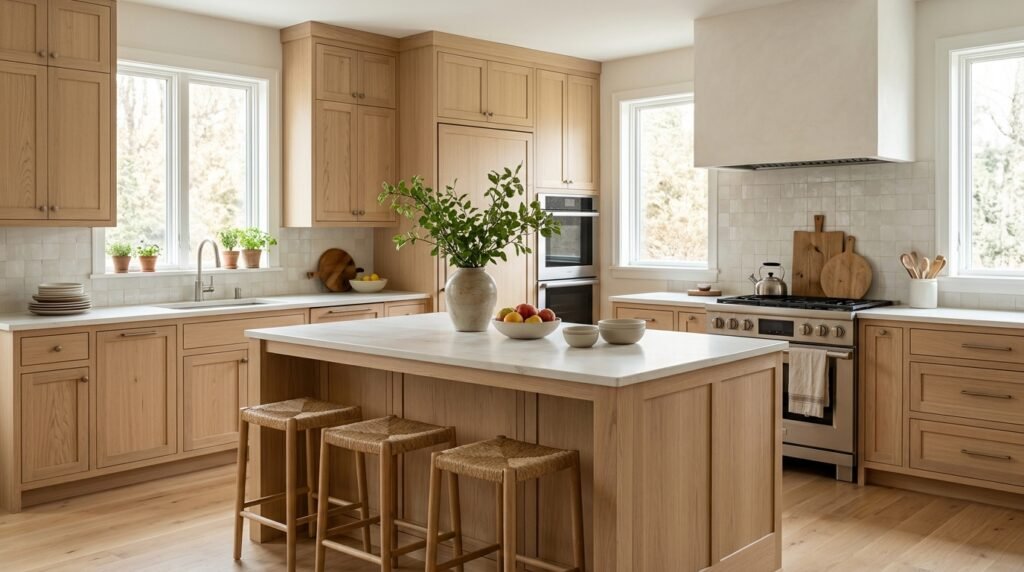
White oak cabinets bring visible wood grain, warm neutral color, and a durable hardwood surface into a kitchen. They work especially well when the goal is a natural kitchen that feels lighter than dark walnut but warmer than painted cabinetry. The most important choice is not simply whether to use oak. Grain selection, door style, stain or clear finish, countertop color, flooring, hardware, and lighting all change how the finished kitchen looks. white oak itself ranges from pale tan to medium brown and can carry olive or gray-brown undertones. Natural variation is part of real wood, so cabinet doors will not look perfectly identical. That is usually an advantage when the design is built around the material rather than trying to make it behave like a flat painted surface. Before ordering, look at full-size finished samples in the actual room. Small online swatches rarely show enough grain, color variation, or interaction with daylight to make a confident decision.
What Makes White Oak a Good Cabinet Wood?
White oak is widely used for cabinetry because it combines strength with a distinctive grain that accepts finishes well. The U.S. Forest Service describes oak as hard, stiff, strong, and commonly used for kitchen cabinets. White oak heartwood also has pores that are often blocked by tyloses, a feature associated with its lower permeability and good natural durability. Those properties help explain the wood’s long history in furniture, flooring, cooperage, and other demanding uses.
For white oak cabinets, however, durability depends on more than the species name. Cabinet construction, joinery, hardware, finish quality, installation, and everyday care matter too. Kitchen cabinetry is an interior product, so the natural decay resistance that makes white oak useful in other applications should not be treated as permission to leave cabinet surfaces wet. Water around sinks, dishwashers, coffee stations, and floor-level panels should still be wiped up promptly. A good cabinet finish protects the surface during normal use, but it does not make wood immune to prolonged moisture.
Understand the Natural Color Before Choosing a Finish
The name “white oak” can be misleading. The heartwood is not white. It commonly appears light to medium brown and may have an olive cast, while the sapwood can be lighter. The grain is generally straight with a coarse, visible texture. That natural character is a major reason white oak cabinets can look warm without appearing orange or heavily rustic.
Finish changes the color considerably. A clear or near-natural finish can deepen the raw wood and emphasize its warmer tones. Pale stains can push the look toward beige, while some muted stains can create a softer brown or slightly gray effect. The final result also depends on the individual boards and finishing system. Do not choose a stain name from a website and assume the kitchen will match it exactly. Ask the cabinetmaker for a representative door sample using the same wood selection, sanding process, stain, and topcoat planned for the project.
White Oak and Red Oak Are Not the Same
White oak and red oak are related, but substituting one for the other can change the appearance. Red oak often has a somewhat redder cast, while white oak can lean more olive or neutral brown. Color alone is not a reliable way to identify every board, however. Their pore structure and ray patterns provide more meaningful differences.
This matters because homeowners sometimes ask for white oak cabinets after seeing a light oak kitchen online, then receive a quote simply labeled “oak.” Confirm the species or commercial wood group being supplied. Also confirm whether the visible material is solid wood, veneer, or a combination. Cabinet construction often uses different materials for doors, face frames, panels, and cabinet boxes. Veneer is not automatically an inferior choice. High-quality veneer can provide stable, visually consistent large surfaces and make efficient use of attractive wood. The key is knowing what is being specified rather than assuming every visible panel is solid lumber.
Grain Cut Can Change the Entire Look
Two kitchens made from the same species can look surprisingly different because of how the log was cut. Plain-sawn or flat-sawn boards often show more sweeping, cathedral-like grain. Quartersawn white oak is known for prominent ray fleck figure and a straighter visual rhythm. Rift-sawn material is often selected when a designer wants a particularly straight, restrained grain appearance.
This distinction is important with white oak cabinets because grain direction covers a large visual area. A contemporary slab-door kitchen may look calmer with consistently oriented straight grain. A more traditional kitchen can comfortably carry stronger figure and variation. Quartersawn material can add visible ray patterns that become a design feature rather than background texture. Terminology and availability can vary among cabinet suppliers, so ask to see actual samples instead of choosing from the cut name alone. Also ask how grain will be matched or oriented across neighboring doors, drawers, end panels, and tall cabinets.
Natural White Oak Cabinets Feel Warm Without Heavy Color
Leaving oak close to its natural appearance is popular because the grain supplies visual interest without relying on a dark stain. Natural white oak cabinets can work with warm white walls, soft stone colors, muted greens, charcoal accents, and many other restrained palettes. Their exact appearance will still depend on the clear coat or finishing system used.
A natural-looking finish is not the same as unfinished wood. Kitchen cabinetry needs an appropriate protective finish supplied and applied according to the cabinet system. The finish can alter sheen and color, so compare samples under both daylight and artificial lighting. Warm bulbs may bring out golden notes. Cooler daylight can make the same doors appear more beige or subdued. If the room has little natural light, a sample viewed in a bright showroom may not predict the final result. Leave the sample in the kitchen for several days and look at it during morning, afternoon, and evening conditions.
Stained White Oak Can Be Light, Medium, or Dramatic
Stain is useful when the natural wood needs to coordinate with flooring, furniture, or a specific interior palette. Light stains can preserve an airy look. Medium brown stains strengthen the grain and create more contrast. Darker finishes can make white oak cabinets feel formal or architectural, although they reduce some of the pale character that draws many homeowners to the species.
The challenge is consistency. Oak’s open grain and natural board variation remain visible after staining, and that is normally part of the material’s character. Sample several doors if possible, not just one small block. If an extremely uniform color is the priority, painted cabinetry or another finish system may suit the design better. Avoid trying to force every board into identical color through aggressive staining. Discuss acceptable variation with the cabinet supplier before production. A clear expectation about sapwood, heartwood, knots, mineral streaks, grain figure, and color range can prevent disappointment after installation.
Door Style Determines Whether the Kitchen Feels Modern or Traditional
Wood species does not lock a kitchen into one design style. Slab doors can give white oak cabinets a clean, modern appearance because the uninterrupted surface makes grain the main detail. Slim-profile or simple Shaker-style doors add structure while keeping the material visible. More detailed frames and profiles can move the same oak toward traditional or transitional design.
The best door style should also reflect cleaning and daily use. Flat fronts have fewer corners where dust and cooking residue can collect. Detailed doors introduce more edges and recesses. Handle choice affects maintenance too, because frequently touching the wood surface around handleless openings can create more visible wear or fingerprints depending on the finish. Before selecting a door from a small showroom display, view an elevation of the entire kitchen. A profile that looks subtle on one door can feel much busier when repeated across twenty cabinets.
Pairing White Oak Cabinets With Countertops
Countertops should either support the warmth of oak or create deliberate contrast. Soft white and off-white surfaces can keep the kitchen bright. Warm gray, taupe, and beige tones often sit comfortably beside natural oak. Dark countertops can create a sharper, more graphic look, especially in modern kitchens. Stone or stone-look surfaces with strong veining require more restraint because both the countertop and wood grain may compete for attention.
With white oak cabinets, compare physical samples side by side. A countertop described as white may contain cool blue-gray, warm cream, gold, brown, or green undertones. Those undertones become more obvious beside real wood. If the oak has a warm finish, a very icy countertop may look disconnected unless other elements intentionally bridge the colors. The backsplash also belongs in this test. Place cabinet, counter, backsplash, hardware, and floor samples together under the room’s actual lighting before making the final decision.
Flooring Needs Enough Difference to Avoid a Wood-on-Wood Blur
Wood flooring can work beautifully with wood cabinetry, but an exact match is rarely necessary. In fact, slightly different tones can make each surface easier to read. The problem occurs when the floor and cabinets are almost the same color but differ just enough in undertone or grain to look accidentally mismatched.
If white oak cabinets sit above wood flooring, compare the two on both horizontal and vertical planes. Light strikes floors differently from doors. Consider grain scale as well as color. A highly active floor combined with strongly figured cabinetry can make a small kitchen visually busy. One solution is to keep one wood surface quieter. Another is to create separation with a contrasting island, rug, toe kick, countertop, or wall color. Existing hardwood floors should be sampled after any planned refinishing, not before. Sanding and a new finish can significantly change how the flooring relates to new cabinets.
Hardware Can Quietly Change the Character
Cabinet hardware occupies little physical space but repeats throughout the room, so its effect adds up. Black pulls create clear contrast against pale white oak cabinets. Brass and bronze tones can reinforce warmth. Nickel and stainless finishes may connect cabinetry with appliances and plumbing fixtures. None of these combinations is universally correct.
Scale is as important as finish. Very long pulls can emphasize horizontal lines on slab doors, while smaller knobs or restrained handles can keep framed doors visually lighter. Think about comfort as well. A handle should be easy to grip without requiring fingers to rub constantly against the cabinet finish. Hardware placement should remain consistent and account for appliance panels, corner cabinets, and adjacent handles that might collide. Before drilling finished doors, mock up the position with removable templates or ask the installer to confirm the hardware layout. A small placement error becomes obvious when repeated across an entire kitchen.
White Oak Works Well in Two-Tone Kitchens
Using oak on every cabinet can be beautiful, but it is not the only option. A two-tone scheme can use white oak cabinets on the island with painted perimeter cabinets, or reverse that arrangement. Tall pantry units can be oak while base and wall cabinets use a quiet painted finish. This approach is useful when the room needs natural texture but too much visible grain would feel heavy.
Choose the split according to architecture rather than randomly alternating colors. A freestanding-looking island is a natural place for a different material. A full wall of tall cabinetry can also read as one intentional wood volume. Keep repeated finishes limited enough that the room remains coherent. If oak, painted cabinets, flooring, countertops, backsplash, metal hardware, and several accent colors all compete equally, the kitchen can lose focus. Let one or two materials lead and allow the rest to support them.
Small Kitchens Need Careful Grain and Contrast
White oak can suit a compact kitchen because light finishes do not visually weigh down the room as much as very dark cabinetry can. Still, pale color alone does not make a room feel larger. Layout, daylight, cabinet height, visual clutter, and contrast all matter.
For small white oak cabinets, a restrained grain selection can keep large runs from appearing too active. Extending cabinetry efficiently to useful height may provide more storage and reduce clutter on countertops, but proportions and access should be considered. Reflective or light-colored surfaces can help distribute available light, while too many contrasting breaks can fragment the room. Avoid shrinking functional elements merely to chase a minimalist look. Full-size appliances, comfortable aisle space, useful drawers, and accessible storage may matter more than creating a perfectly symmetrical elevation. A compact kitchen succeeds when every cabinet has a clear job.
White Oak Cabinets Need Thoughtful Lighting
Wood color changes noticeably under different light. That makes lighting part of the cabinet-selection process rather than a final decorative choice. Daylight varies by orientation and time of day. Artificial lamps also differ in color appearance and color rendering. A finish that appears neutral in one showroom can look much warmer at home.
Use layered lighting around white oak cabinets. General ceiling lighting handles overall visibility. Task lighting under wall cabinets can illuminate work surfaces. Pendant or decorative lighting may support islands or dining areas. Avoid placing light solely for dramatic cabinet highlights while leaving counters poorly lit. Also watch for uneven lighting that makes neighboring doors appear to be different colors when they are not. Before approving a stain, view the sample under the lighting planned for the completed room. This is particularly important when coordinating oak with white paint, stone, and metal finishes, because small undertone differences become easier to see.
Real Wood Variation Is a Feature, but Set Expectations
Natural wood is not printed material. Grain direction, ray figure, color, and markings vary from board to board. That variation gives white oak cabinets depth, but it can surprise someone expecting the uniformity of a painted door or synthetic wood pattern.
Ask how the cabinet company selects and lays out visible pieces. Some manufacturers may offer different appearance grades, grain selections, or matching options. Do not assume terms mean exactly the same thing across suppliers. Request written descriptions and representative finished samples. If strong color variation, knots, or sapwood are undesirable, discuss that before the order rather than after installation. At the same time, demanding perfect uniformity can work against the reason for choosing real oak. A successful wood kitchen usually has controlled variation: enough consistency to feel designed, but enough natural difference to show that the material is genuine.
Cleaning Should Be Gentle and Consistent
Daily care of white oak cabinets should follow the cabinet manufacturer’s finish instructions because cleaning recommendations can vary by coating. In general, remove spills promptly, especially around sinks and cooking areas. Use a soft cloth and avoid leaving standing water on doors, seams, edges, or cabinet bottoms. Grease is easier to manage when it is cleaned regularly rather than allowed to build into a sticky film.
Do not assume a strong household cleaner is safe simply because the wood has a protective topcoat. Abrasive pads, harsh solvents, and unsuitable chemicals can dull or damage some finishes. Spray cleaners onto a cloth when recommended rather than flooding joints and edges. Pay attention to high-touch zones near pulls and around waste drawers. If a cabinet finish becomes damaged, identify the original finishing system before attempting a DIY stain or clear-coat repair. Spot repairs can become more noticeable than the original mark when sheen or color does not match.
Moisture Problems Usually Start at Vulnerable Areas
Kitchens expose cabinetry to steam, splashes, leaks, and cleaning water. White oak’s material properties do not eliminate those risks. Sink bases, dishwasher edges, toe kicks, coffee stations, and cabinets near plumbing deserve regular attention. A slow leak can damage cabinet components before a puddle becomes obvious.
Inspect white oak cabinets after plumbing work and whenever unexplained swelling, staining, odor, finish cloudiness, or panel movement appears. Fix the moisture source first. Drying and cosmetic repair will not solve an active leak. Use exhaust ventilation during moisture-producing cooking when appropriate, and do not hang wet towels over cabinet doors for long periods. Wood responds to environmental moisture, so stable indoor conditions and a properly functioning kitchen are better protection than relying on the species alone. For significant water damage, cabinetmakers or restoration professionals can help determine whether a component can be repaired or should be replaced.
White Oak Veneer Can Be a Smart Cabinet Material
The word “veneer” sometimes gets treated as shorthand for low quality, but that is too simple. Veneer is a thin layer of real wood applied to a suitable substrate. In cabinetry, it can create broad, stable surfaces while preserving the appearance of genuine oak. It is particularly useful on slab doors, end panels, and other areas where wide solid boards could move more with changes in moisture.
A kitchen may therefore combine solid white oak cabinets components with white oak veneer, engineered panels, and other materials. Ask for the construction specification rather than judging quality from one word. Find out which parts are solid wood, which are veneered, what substrate is used, how exposed edges are treated, and how the finish is applied. High-quality construction should be evaluated as a system. Door stability, box construction, drawer hardware, hinges, finish quality, installation, and service support can matter as much as whether every visible component began as a thick piece of lumber.
Cost Depends on More Than the Wood Species
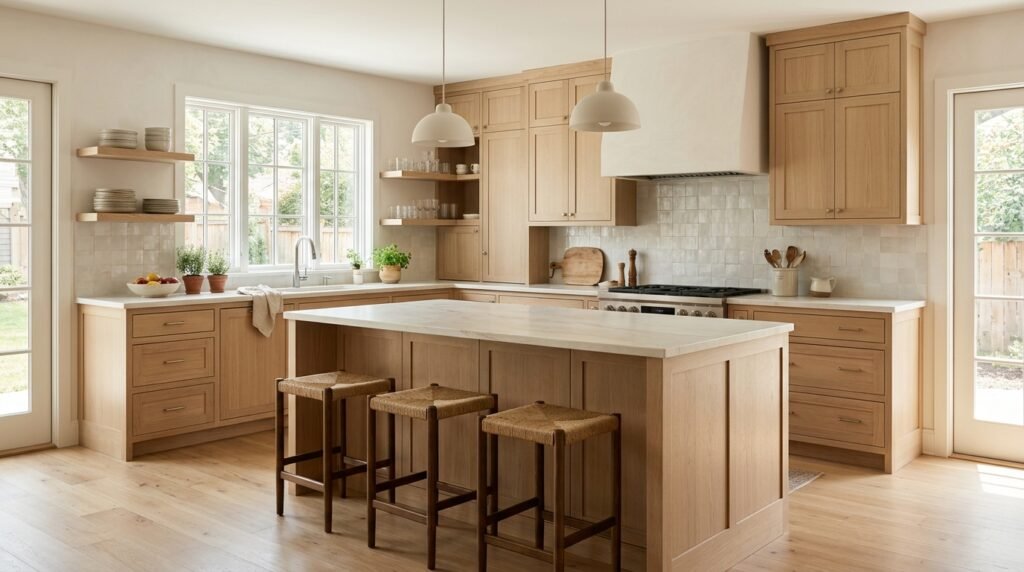
It is difficult to give one meaningful price for white oak cabinets because cabinetry is usually priced as a complete project. Door style, grain selection, construction method, custom sizing, finish, interior accessories, hardware, installation, location, and the number of cabinets all affect the final quote. Rift or quartersawn appearance requirements may also change material selection and cost.
Compare proposals line by line. One quote may include finished end panels, crown, fillers, appliance panels, installation, and premium drawer systems, while another does not. A lower cabinet price can become less competitive after those pieces are added. If the budget is tight, simplify the design before sacrificing the parts that affect daily use. Fewer decorative moldings, a simpler door, standard cabinet sizes where appropriate, or using oak only on an island can preserve the desired material while controlling scope. Get current local quotes rather than relying on broad online price ranges.
How to Choose White Oak Cabinets Without Regret
Start with the room rather than a trend photograph. Note the existing flooring, daylight, ceiling height, appliance finishes, and any materials that will remain. Decide whether the kitchen should feel pale and quiet, warm and organic, strongly modern, or more traditional. That direction will narrow the grain, door, and finish choices.
Next, collect large samples. Compare white oak cabinets finishes with the actual countertop, backsplash, floor, wall paint, and hardware. Look at them in the room throughout the day. Ask the supplier about species, cut, veneer use, acceptable natural variation, door construction, finish system, cleaning instructions, hardware, and warranty terms. Review elevations so grain direction and panel transitions are understood before production. Finally, spend money where it affects long-term function: sound cabinet construction, useful storage, reliable hardware, good installation, and an appropriate finish. Decorative details can be simplified much more easily than poorly planned cabinetry can be corrected.
Frequently Asked Questions
Are white oak cabinets durable?
Yes. White oak is a hard, strong hardwood widely used for cabinetry, furniture, and flooring. Cabinet durability still depends on construction, finish, hardware, installation, moisture control, and care, so species alone does not determine the lifespan of a kitchen.
Do white oak cabinets turn yellow?
Wood and finishes can change appearance with age and light exposure, but the amount and direction of change depend on the wood, finishing system, and environment. Ask the cabinet manufacturer how the selected finish is expected to age rather than assuming every natural oak kitchen will change in the same way.
Are white oak cabinets suitable for modern kitchens?
Yes. Slab doors, restrained grain, simple hardware, and clean detailing can make oak look distinctly modern. Framed doors and more visible grain can move the same wood toward transitional or traditional design.
What countertops look good with white oak?
Warm whites, creams, taupes, soft grays, and dark contrasting surfaces can all work. The right choice depends on the oak finish and its undertones. Always compare physical samples under the kitchen’s real lighting before ordering.
Is white oak better than red oak for cabinets?
Neither is automatically better for every kitchen. Both are established cabinet woods. White oak generally has a more olive or neutral-brown character, while red oak often appears redder. Grain, cut, finish, availability, and the desired design should guide the choice.
Are white oak cabinets hard to maintain?
Routine care is usually straightforward when the finish is appropriate and manufacturer’s instructions are followed. Wipe spills promptly, avoid prolonged moisture, and use cleaning methods approved for the finish. Areas near sinks and dishwashers deserve extra attention.
A Material Worth Choosing Deliberately
White oak cabinets work because they combine useful hardwood properties with grain and color that can fit many kitchen styles. They can feel quiet and contemporary with slab doors and a pale finish, or warmer and more traditional with framed doors and stronger grain. The material is versatile, but the best results come from making deliberate choices rather than simply requesting “natural oak.”
Focus first on the exact wood appearance, door style, finish, construction, and grain direction. Then compare those decisions with the countertop, flooring, hardware, wall color, and actual lighting. Confirm what is solid wood and what is veneer, understand the supplier’s acceptable natural variation, and follow the finish maker’s care guidance after installation. When those details are resolved before production, white oak cabinets can provide a kitchen with natural texture, practical durability, and a design that does not depend on short-lived decoration.