
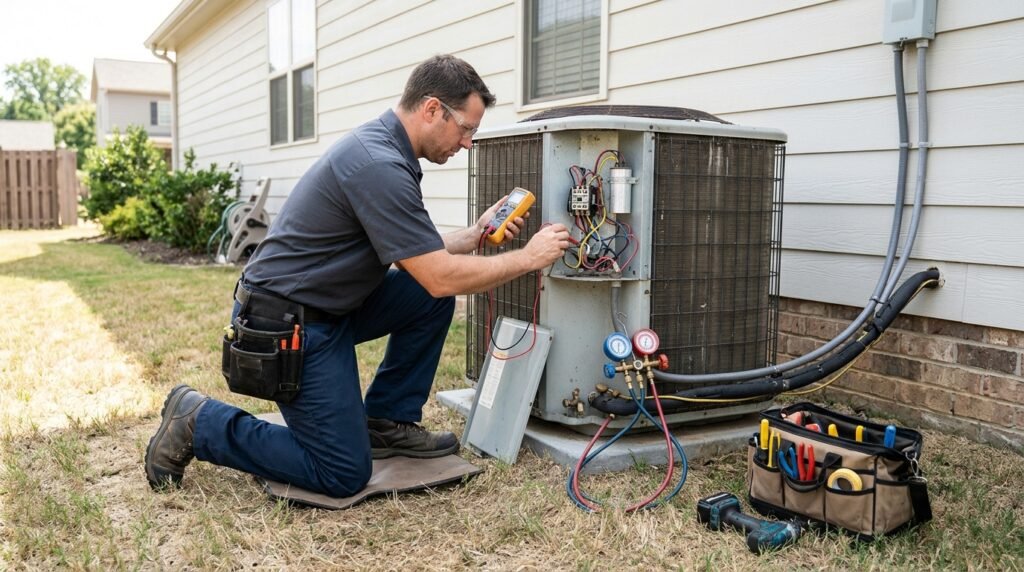
Emergency AC repairs become necessary when an air-conditioning problem creates an immediate safety concern, threatens the equipment or home, or leaves occupants exposed to dangerous heat. A system that stops cooling on a mild day is inconvenient, but it may not always be an emergency. Burning smells, smoke, repeated electrical trips, unusual electrical noises, major water leakage near electrical equipment, or a complete cooling failure during extreme heat deserve faster attention. The urgency also increases when older adults, young children, or people with certain health conditions are inside the home. CDC guidance notes that hot weather can affect anyone and that some groups face greater heat-related risk. Before calling a technician, homeowners can safely check the thermostat, air filter, accessible vents, and electrical panel for an obviously tripped breaker. However, refrigerant circuits, internal electrical components, compressors, capacitors, and other technical repairs should be left to qualified professionals. EPA rules also require certification for technicians performing work that can release regulated refrigerants. Knowing what qualifies as urgent, what can safely be checked, and when the system should remain off can prevent a stressful breakdown from becoming a larger problem.
What Counts as an AC Emergency?
Not every cooling problem requires an after-hours service call. Emergency AC repairs make the most sense when waiting could create a health risk, electrical hazard, significant water damage, or additional equipment failure. Smoke or a burning electrical odor should be treated seriously. A breaker that repeatedly trips after the air conditioner starts also deserves professional diagnosis rather than repeated resetting. Major water leakage around electrical equipment can create another reason to shut the system down and seek help. A complete loss of cooling becomes more urgent during dangerous outdoor heat, particularly in homes with people who are more vulnerable to heat illness. CDC guidance says older adults are more prone to heat-related health problems and recommends staying in air-conditioned places during hot weather. By contrast, a system that is still cooling but has a minor comfort problem may sometimes wait for normal service hours. The safest decision depends on the symptoms, indoor conditions, weather, occupants, and whether continuing to operate the equipment could cause harm.
Start With Safe Checks Before Calling for Service
A few basic checks can sometimes reveal a simple problem without opening the equipment. Confirm that the thermostat is set to cooling and that the desired temperature is below the current room temperature. If the thermostat display is blank, check its batteries if the model uses replaceable batteries. Inspect the HVAC filter and replace it if it is clearly dirty and the system instructions allow homeowner replacement. Make sure accessible supply and return vents have not been accidentally covered by furniture or other objects. Check the electrical panel for a clearly tripped HVAC breaker, but do not keep resetting a breaker that trips again. Emergency AC repairs are appropriate when a repeated trip suggests an electrical or equipment fault. Also look around the indoor and outdoor units from a safe distance for water, ice, smoke, unusual vibration, or damaged wiring. These observations can help the technician later. Do not remove electrical access panels, touch capacitors, bypass switches, open refrigerant lines, or attempt internal electrical testing without appropriate training.
A Complete Loss of Cooling Can Have Several Causes
An air conditioner that suddenly blows warm air or stops operating can fail for many reasons, and the symptom alone does not identify the defective part. A thermostat or control problem can prevent a cooling call from reaching the equipment. An electrical fault can stop an indoor blower, outdoor fan, compressor, or the whole system. Restricted airflow can contribute to poor performance and coil icing. Refrigerant-related problems can also reduce cooling capacity, while mechanical failures can prevent the refrigeration cycle from operating correctly. Emergency AC repairs should therefore begin with diagnosis rather than replacing parts based on a guess. Notice whether the thermostat is working, whether the indoor fan operates, whether air is coming from the vents, and whether the outdoor unit appears to start. Tell the technician what happened before the failure, including unusual noises, odors, breaker trips, ice, water, or declining cooling performance. A clear description can shorten the diagnostic process, but internal testing should still be performed by someone qualified to work on the system.
Burning Smells or Smoke Require Immediate Caution
A faint dusty smell can occur when some HVAC systems are first used after a long inactive period, but a strong burning, melting-plastic, electrical, or smoky odor is different. If smoke is visible or there appears to be an active fire, leave the building as appropriate and contact emergency services rather than treating the situation as a routine HVAC appointment. If there is no fire but the air conditioner produces a strong electrical burning smell, turn it off if that can be done safely and arrange professional inspection. Emergency AC repairs may uncover overheated wiring, a failing motor, damaged electrical connections, or another electrical fault, but the cause cannot be determined from odor alone. Do not remove equipment panels to search for a burned component. HVAC systems can contain line-voltage circuits and components that retain electrical energy. Continuing to operate a system that smells electrically burned can worsen damage. Repeatedly restarting it to see whether the smell disappears is also a poor troubleshooting method. The technician should inspect the relevant electrical and mechanical components before the system returns to normal operation.
A Repeatedly Tripping Breaker Is Not a Resetting Problem

A circuit breaker is a protective device, so repeated tripping should be treated as a symptom rather than an inconvenience. One isolated trip can have several explanations, but a breaker that trips whenever the air conditioner starts should not be reset again and again. Emergency AC repairs may be justified if cooling is essential or the electrical behavior suggests a developing fault. Possible causes can involve wiring, motors, compressors, electrical components, or conditions that increase current draw, but proper testing is needed before naming the cause. Do not install a larger breaker in an attempt to stop the tripping. Circuit protection must match the electrical system and equipment requirements. Likewise, do not bypass fuses, disconnects, switches, or other protective devices. If there is heat, discoloration, buzzing, arcing, smoke, or a burning odor near the electrical panel or HVAC equipment, keep clear and seek qualified electrical or HVAC help. Depending on where the fault lies, an electrician may be needed in addition to an HVAC technician.
Ice on the Air Conditioner Is a Warning Sign
Ice on refrigerant lines or an indoor evaporator coil does not mean the air conditioner is producing extra cooling. It usually indicates that operating conditions are allowing part of the system to become abnormally cold. Restricted airflow is one possible contributor, which is why a heavily clogged filter is worth checking. Other problems can also cause freezing, including faults that require professional diagnosis. If significant ice is visible, continuing to run the cooling cycle can make troubleshooting harder and may place more stress on the equipment. Emergency AC repairs may be needed during severe heat or when the freezing repeatedly returns. Turning off cooling and allowing the system to thaw can be appropriate while waiting for service, but do not chip ice from the coil or tubing with a tool. Doing so can damage delicate components. A technician needs the underlying cause, not merely the visible ice, corrected. If a filter replacement appears to restore operation but the system freezes again, the recurring symptom is evidence that further inspection is needed.
Water Around the Indoor Unit Needs Investigation
Air conditioners remove moisture from indoor air during normal cooling, and that condensate must be carried away through the system’s drainage arrangement. Water collecting around an indoor unit can indicate a blocked drain, overflowing drain pan, frozen coil that is thawing, pump problem, damaged drainage component, or another fault. The exact cause depends on the equipment. Emergency AC repairs become more important if water is approaching electrical components, leaking through ceilings, soaking flooring, or causing significant property damage. Turn off the equipment if continuing operation appears to be producing more water and it is safe to do so. Do not assume every HVAC water leak is harmless condensation. Water can damage drywall, insulation, ceilings, flooring, cabinetry, and nearby electrical equipment. A small accessible drain problem may sometimes be straightforward, but hidden drainage systems and attic installations can make the situation more complicated. After the leak is repaired, wet building materials may also need proper drying to limit secondary moisture problems.
Strange Noises Can Reveal How Urgent the Problem Is
Air-conditioning equipment naturally produces fan, airflow, compressor, and refrigerant sounds, so a familiar operating noise is not automatically a problem. A sudden new noise deserves more attention. Loud grinding, harsh scraping, repeated banging, strong rattling, electrical buzzing, or metal-on-metal sounds can indicate a mechanical or electrical issue. Emergency AC repairs may prevent additional damage if a component is failing and continued operation would make the problem worse. Turn the system off when the noise is severe or clearly abnormal rather than repeatedly restarting it for testing. A small outdoor-unit rattle caused by loose debris is different from a violent mechanical sound coming from inside the equipment. Do not reach through fan guards or place hands inside an outdoor unit, even if the fan appears stopped. Power can be restored automatically through controls. Record the sound from a safe distance if doing so does not place anyone near moving or electrical parts. A recording can sometimes help a technician understand an intermittent problem that stops before arrival.
Weak Airflow Is Different From Warm Air
Weak airflow and warm air can feel similar because both make a house uncomfortable, but they point toward different categories of problems. Weak airflow means little air is reaching the room even if that air is somewhat cool. A dirty filter, blocked return, duct problem, blower issue, frozen coil, or other airflow restriction may be involved. Warm airflow means air is moving but is not being cooled as expected. Emergency AC repairs may involve both symptoms when a larger system failure develops, but diagnosing them separately gives the technician better information. Check an accessible filter and make sure vents are open and unobstructed. Do not assume closing many vents will force more useful cooling into the remaining rooms; HVAC systems are designed around airflow requirements, and major changes can affect operation. If airflow suddenly drops throughout the home, the problem is more likely to involve shared equipment or ductwork than one individual register. A single weak room may instead point toward a local duct, damper, or register issue.
Refrigerant Problems Require Qualified Service
Refrigerant is part of a sealed refrigeration circuit, and homeowners should not treat adding refrigerant like topping up windshield washer fluid. A properly diagnosed system needs the reason for abnormal refrigerant conditions identified. EPA Section 608 requirements apply to technicians performing work that could release refrigerants from stationary air-conditioning equipment. EPA specifically states that attaching or detaching hoses and gauges, adding or removing refrigerant, and other activities that can violate the integrity of the refrigerant circuit require appropriate certification. EPA also prohibits intentional venting of many refrigerants during service and repair. For these reasons, emergency AC repairs involving suspected refrigerant loss should be handled by an appropriately certified technician. EPA advises homeowners to use reputable dealers employing Section 608-certified technicians for refrigerant service. Do not puncture tubing, loosen fittings, attach DIY charging equipment, or deliberately release refrigerant. If cooling performance has declined because of a refrigerant-related fault, diagnosis should determine what repair is actually required before the system is returned to service.
The Outdoor Unit Needs Clear Airflow
The outdoor condenser must exchange heat with outside air, so severe obstruction around it can interfere with normal operation. Leaves, vegetation, trash, and other debris can accumulate around outdoor equipment. A homeowner can visually check the surrounding area and remove loose debris that is safely accessible without opening the unit or contacting electrical parts. Keep hands, tools, and clothing away from fan openings. Emergency AC repairs may still be required if the outdoor fan does not run, the unit makes severe noises, the breaker trips, or the equipment shows signs of electrical or mechanical failure. Do not assume washing the unit will fix every cooling problem, and never spray water into electrical compartments. Maintenance instructions vary by manufacturer and model. Damage to the coil, fan, wiring, controls, or compressor requires a different response from ordinary debris removal. If the condenser is located on a roof or other difficult location, avoid unsafe access. Professional service is safer than climbing into a hazardous area simply to investigate a cooling failure.
Thermostat Problems Can Look Like Major AC Failures
The thermostat is the control point homeowners interact with most, so a simple setting error can sometimes look like a failed air conditioner. Confirm that the system is set to cool rather than heat or fan-only mode. Check the temperature setting and thermostat display. If the thermostat uses batteries, weak batteries can be an easy issue to rule out. Smart thermostats may also depend on wiring, power, configuration, or communication with HVAC equipment. Emergency AC repairs are not always necessary when the problem begins at the thermostat, but repeated blank screens, error messages, or a system that ignores correct settings may need diagnosis. Avoid jumping thermostat wires or bypassing controls without proper training. HVAC controls can connect to equipment that has both low-voltage control circuits and higher-voltage power. If the thermostat appears normal but neither indoor nor outdoor equipment responds, tell the service technician what the display shows and whether any recent electrical outage, thermostat replacement, renovation, or wiring work occurred.
Extreme Heat Can Turn a Breakdown Into a Health Issue
A cooling failure becomes more serious when indoor temperatures rise during extreme heat. CDC guidance says hot weather can affect anyone and identifies older adults and people with certain chronic health conditions among groups that can face increased risk. If emergency AC repairs cannot restore cooling quickly, protecting occupants becomes more important than protecting the house. CDC recommends staying hydrated and using air-conditioned locations when home cooling is unavailable. It also warns that fans alone may not prevent heat-related illness in very hot conditions; current CDC guidance says fans should only be used indoors when temperatures are below 90°F. A library, shopping center, cooling center, relative’s home, or other conditioned location may provide temporary relief. Seek medical care for concerning heat-related symptoms according to current health guidance. Do not wait beside a failed air conditioner if someone is becoming ill. HVAC service addresses the equipment, while medical professionals address heat illness.
Older Adults and Other Vulnerable Occupants Change the Urgency
The same AC failure can have very different consequences in two households. CDC states that adults aged 65 and older are more prone to heat-related health problems because they may adjust less effectively to sudden temperature changes and may have health conditions or medications that affect temperature regulation. People with certain chronic conditions can also be more vulnerable during high heat. Emergency AC repairs should therefore be prioritized based partly on who is inside the building, not simply on the equipment fault. If a vulnerable person cannot safely remain in a hot home, arrange access to an air-conditioned location while repairs are underway. Keep medications and medical equipment within their required storage conditions and follow healthcare guidance relevant to the individual. Do not assume a portable fan makes an extremely hot room safe. Cooling the person and reaching a safe environment can be more urgent than waiting for the technician to complete a diagnosis.
What to Do While Waiting for an HVAC Technician
After making the system safe, focus on reducing heat gain and protecting occupants. Close blinds or curtains where direct sunlight is heating the home. Avoid using ovens and other heat-producing appliances when practical. CDC specifically recommends using stoves and ovens less during hot weather when air conditioning is unavailable. Stay hydrated and move to a cooler location if indoor conditions become unsafe. If the HVAC system has a serious electrical symptom, burning odor, severe mechanical noise, major leak, or repeated breaker trip, leave it off until it is inspected. Emergency AC repairs can be easier to diagnose when homeowners provide useful information, so note the thermostat setting, indoor temperature, unusual noises, visible ice, leaks, odors, breaker behavior, and when the problem began. Gather the equipment model information if it is safely accessible. Do not disassemble the unit while waiting. A technician benefits more from an undisturbed fault and accurate symptom history than from a partially dismantled system.
What an Emergency HVAC Technician May Check
The exact diagnostic process depends on the equipment and symptoms, so there is no universal emergency service checklist. A technician may evaluate thermostat operation, electrical power, controls, airflow, filters, blower operation, outdoor components, temperature changes, condensate drainage, and the refrigeration circuit as relevant. Emergency AC repairs should be based on measurements and inspection rather than immediately assuming a compressor or refrigerant problem. If refrigerant work is required, EPA certification rules apply to activities that can release refrigerant. A technician may also need to determine whether a failed component is the root problem or a result of another condition. For example, replacing one damaged electrical part without addressing the condition that caused overheating may not provide a lasting repair. Homeowners can ask what failed, what evidence supports the diagnosis, whether another fault contributed, what repair is proposed, and whether the system can safely operate before additional work is completed. Clear explanations are especially valuable during after-hours calls, when decisions often need to be made quickly.
Emergency Repair Does Not Always Mean Replacing the System
A sudden breakdown can make replacement feel inevitable, but many faults can be repaired. The correct choice depends on the failed component, system condition, refrigerant type, repair feasibility, age, efficiency, history, availability of compatible parts, and cost of keeping the equipment reliable. Emergency AC repairs should first establish what has actually failed. A thermostat fault and a failed compressor are very different decisions. Repeated major failures on an older system can make replacement worth considering, while an isolated repair on otherwise sound equipment may not justify replacing the entire installation. Avoid making a large purchase based only on a technician saying the unit is “old.” Ask for the diagnosis and repair options. At the same time, age should not be ignored when a system needs frequent expensive work. EPA advises consumers working with air-conditioning equipment to use reputable dealers and appropriately certified technicians for refrigerant handling. A second opinion can be reasonable before a costly replacement when immediate safety does not require a same-day decision.
Emergency AC Repair Costs Vary Too Much for One Reliable Price
There is no responsible universal price for emergency AC repairs because the phrase covers everything from a minor control problem to a major compressor or refrigerant-circuit failure. Location, system type, labor rates, after-hours fees, required parts, accessibility, refrigerant, diagnosis time, and the actual defect can all change the total. A rooftop unit may require different access and labor from a ground-level residential condenser. An inexpensive component can still involve significant diagnostic or after-hours labor. Refrigerant-related work may involve leak diagnosis and certified service rather than simply adding material. Before authorizing work, ask what the diagnostic fee covers, whether an emergency or after-hours surcharge applies, what part or repair is recommended, and whether labor and parts warranties are included. If a temporary repair is proposed, ask what remains unresolved. Avoid contractors who quote a major repair with no diagnosis or pressure immediate replacement without explaining the failed component. A written estimate makes it easier to understand what is being purchased and compare options when circumstances allow.
Choosing an Emergency AC Repair Company Requires More Than Speed
Fast arrival matters during a severe breakdown, but technical qualifications and business practices matter too. For refrigerant work in the United States, EPA advises homeowners to use reputable dealers employing technicians with Section 608 certification. EPA requires certification for technicians whose service activities can reasonably be expected to release refrigerants. Licensing requirements for HVAC contractors vary by state and locality, so homeowners should check the rules that apply where the property is located. Ask whether the company is appropriately licensed where required, insured, experienced with the equipment type, and able to explain its emergency fees before dispatch when possible. Emergency AC repairs performed under pressure can make homeowners vulnerable to vague recommendations, so request a diagnosis before approving expensive work. A trustworthy technician should be able to describe the symptom, testing performed, identified fault, proposed correction, and any limitations. Speed is useful, but a fast wrong repair can lead to another breakdown.
DIY Work Should Stop Before Refrigerant or Internal Electrical Repairs
Homeowners can handle basic observations and routine tasks such as checking thermostat settings, inspecting an accessible filter, and keeping obvious debris away from equipment. The boundary becomes much clearer once a repair requires opening electrical compartments, testing energized components, accessing capacitors, altering wiring, or disturbing the refrigerant circuit. EPA defines several activities that can violate the integrity of a refrigerant circuit, including attaching gauges, adding or removing refrigerant, removing components, and cutting refrigerant lines. These activities fall within regulated technician work. Emergency AC repairs involving electricity also carry shock, fire, and equipment-damage risks. Watching an online repair video does not establish that a procedure is safe for a particular unit. Models use different components, wiring, controls, refrigerants, and service procedures. Use the equipment documentation for approved homeowner maintenance and leave technical diagnosis to qualified personnel. Saving a service fee is not worthwhile if the attempt creates an electrical hazard, releases refrigerant, damages an expensive component, or hides the original fault.
Preventive Maintenance Can Reduce Some Emergency Breakdowns
No maintenance plan can guarantee that an air conditioner will never fail, but routine care can reduce avoidable problems and help identify deterioration earlier. Replace or clean homeowner-serviceable filters according to the equipment and filter instructions. Keep outdoor equipment free from severe obstruction and vegetation while following manufacturer clearance guidance. Watch for unusual noises, declining airflow, repeated icing, drainage problems, breaker trips, or longer-than-normal cooling cycles rather than waiting until the system stops completely. Arrange professional maintenance at intervals appropriate for the equipment, climate, usage, and manufacturer guidance. Emergency AC repairs are often more disruptive during the hottest weather, when service demand can also be high. Keeping equipment information, service records, warranty details, and the contact information of a trusted HVAC contractor in one place can make an unexpected failure easier to manage. Maintenance cannot prevent every motor, control, electrical, or mechanical failure, but it can turn some developing problems into planned repairs rather than after-hours emergencies.
Do Not Ignore a System That Starts Working Again
Intermittent faults can be frustrating because the air conditioner may fail, restart later, and appear normal. That does not prove the problem has disappeared. An overheating motor may stop and later restart. A control or electrical connection may behave intermittently. A drain safety switch may interrupt operation when water accumulates and allow it to resume later. Ice can thaw and temporarily restore airflow. Emergency AC repairs may still be appropriate if the original symptom involved burning odors, repeated breaker trips, severe noises, or loss of cooling during dangerous heat. Record what happened before the system recovered. Note how long it stopped, what the thermostat displayed, whether the breaker moved, and whether there was ice or water. Avoid deliberately forcing repeated failures to reproduce the symptom. Intermittent problems can be harder to diagnose, but a technician can often use operating measurements, fault history, control codes, and visual evidence to narrow the cause. A system that “fixed itself” may simply be between failures.
FAQs
When are emergency AC repairs really necessary?
Emergency AC repairs are most justified when an air-conditioning failure creates a health or safety concern, risks significant property or equipment damage, or occurs during dangerous heat with vulnerable occupants. Smoke, strong electrical burning odors, repeated breaker trips, severe leaks near electrical components, and major mechanical noises also deserve prompt attention.
Should I turn my AC off if it is making a loud noise?
A severe new grinding, scraping, banging, or electrical buzzing sound is a reasonable reason to stop the system and arrange inspection. Continuing to run equipment with an obvious mechanical or electrical problem can potentially worsen the fault.
Can I add refrigerant to my home AC myself?
Refrigerant service should be left to qualified technicians. EPA requires Section 608 certification for technicians performing activities that could release refrigerant, including adding or removing refrigerant and connecting service gauges to applicable stationary AC equipment.
What should I do if my AC fails during extreme heat?
Reduce indoor heat gain, stay hydrated, avoid unnecessary heat-producing appliances, and move to an air-conditioned location if the home becomes unsafe. CDC advises using air conditioning or finding a cooled location during high heat and warns that fans alone are not enough under very hot indoor conditions.
Why does my air conditioner keep tripping the breaker?
Several electrical or mechanical faults can cause repeated breaker trips, so the exact cause requires diagnosis. Do not repeatedly reset the breaker or install a larger one. Leave the system off and arrange qualified service if it trips again after an initial reset.
Can emergency AC repairs wait until morning?
Sometimes they can. A minor comfort problem in safe weather may be suitable for normal service hours. Waiting is less appropriate when there is smoke, a burning electrical smell, severe leaking, repeated electrical trips, dangerous heat, vulnerable occupants, or evidence that continued operation could cause further damage.
Conclusion
Emergency AC repairs are not defined simply by an air conditioner failing after normal business hours. The real question is whether the failure threatens safety, health, property, or the equipment itself. Start with simple checks such as thermostat settings, the accessible filter, vents, and a visibly tripped breaker, but stop if the system shows serious electrical, mechanical, refrigerant, or water-related symptoms. Refrigerant work should be handled by appropriately certified professionals, and EPA requires Section 608 certification for service activities that can release regulated refrigerants. During extreme heat, occupant safety comes first. CDC recommends staying cool, hydrated, and using an air-conditioned location when the home cannot be kept safe. A clear description of the failure, sensible temporary precautions, and a qualified technician can turn an urgent cooling breakdown into a controlled repair rather than a larger emergency.