
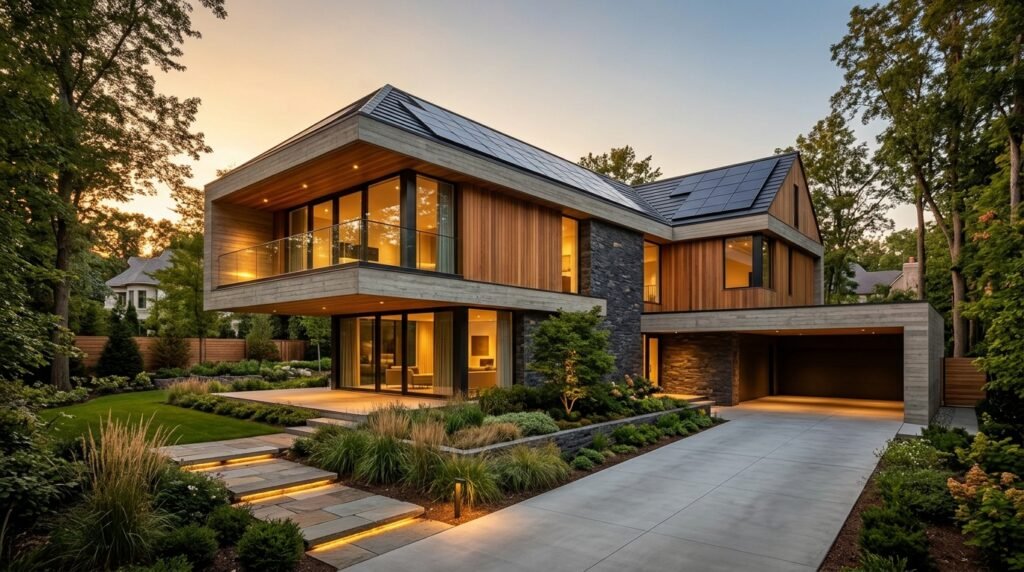
A futuristic house is more than a home with unusual curves, glass walls, and automated lights. The strongest future-focused homes combine architecture, energy efficiency, smart technology, flexible spaces, comfort, and sustainability into one connected design. Some features that once seemed futuristic are already practical today. Solar panels, battery storage, heat pumps, smart controls, automated shading, advanced insulation, electric vehicle charging, and connected security systems can all be incorporated into modern homes. The U.S. Department of Energy describes advanced grid-interactive buildings as efficient, connected, smart, and flexible, while current building research also focuses heavily on stronger envelopes and energy storage. A future-ready home therefore does not need to resemble a science-fiction movie. It needs to work intelligently. Good design should lower wasted energy, adapt to changing household needs, simplify daily routines, and remain comfortable when technology changes. This guide explores the architecture, rooms, materials, energy systems, smart features, costs, and practical decisions that can turn the idea of a future home into something genuinely useful.
What Is a Futuristic House?
A futuristic house is a home designed around forward-looking ideas in architecture, technology, energy, materials, and everyday living. There is no single architectural style that defines it. One home might have flowing forms, large windows, and a minimalist interior. Another may look fairly traditional from outside while hiding sophisticated energy and automation systems within its walls. What makes the design future-focused is the way the building responds to modern and emerging needs. A strong design may combine a high-performance thermal envelope, efficient heating and cooling, renewable electricity, battery storage, smart lighting, automated climate control, water-saving fixtures, electric vehicle charging, and adaptable rooms. DOE guidance on high-performance homes emphasizes that components should work together as a complete system rather than as isolated upgrades. That systems approach is important. Installing dozens of connected gadgets does not automatically create an advanced home. Architecture and technology should solve real problems and improve comfort, efficiency, durability, safety, or convenience.
Futuristic Architecture Is About More Than Unusual Shapes
Images of future homes often show dramatic cantilevers, curved walls, huge glass panels, floating staircases, and white surfaces. These elements can create a futuristic appearance, but visual drama should not replace practical architecture. A successful futuristic house still needs comfortable rooms, sensible circulation, privacy, storage, weather protection, structural integrity, and easy maintenance. Form should respond to the site and climate. Large areas of glass can provide excellent daylight and views, yet their orientation and performance affect heat gain, heat loss, glare, and comfort. Deep roof overhangs and exterior shading may help control direct sunlight in suitable climates. Courtyards can bring daylight into deeper floor plans while creating protected outdoor spaces. Flexible partitions can make rooms adaptable without requiring an unusual exterior. The most convincing future architecture often combines bold design with quiet practicality. A house can look advanced without becoming difficult to furnish, clean, repair, cool, or heat. Long-term usefulness should guide the architecture before visual novelty.
The Building Envelope Comes First
One of the least glamorous parts of a futuristic house may also be one of the most important: its building envelope. The envelope includes elements that separate indoor and outdoor conditions, such as walls, roofs, foundations, windows, and doors. DOE describes the envelope as a critical part of energy performance because heat can move through these components and through air leaks. Good insulation, careful air sealing, high-performance windows, moisture management, and reduced thermal bridging can lower the amount of heating and cooling a home needs. This creates a better foundation for everything that follows. A highly efficient heat pump, solar array, or intelligent thermostat cannot fully compensate for a poorly designed house that constantly loses conditioned air. DOE’s current home-energy guidance recommends an “envelope-first” approach when weatherization is needed because reducing heating and cooling loads can also support more effective electrification. Future-ready design therefore begins with building science, not a touchscreen.
Smart Home Technology Should Work Quietly
A genuinely smart home should require less attention, not more. Lights can respond to occupancy and daylight. Climate controls can adjust according to schedules, room use, or household preferences. Motorized shades can reduce unwanted solar gain. Door locks, cameras, leak sensors, smoke alarms, and other safety devices can provide useful alerts. Appliances may coordinate with energy prices or available solar power where compatible systems and utility programs exist. DOE’s grid-interactive building work explores how connected controls and flexible loads can help buildings adjust energy use while maintaining comfort. In a well-designed futuristic house, automation should operate in the background while preserving simple manual control. This matters because overly complex systems can become frustrating. Residents should still be able to turn on a light, change a temperature, open a shade, or unlock a door without navigating several apps. Good smart-home planning also considers cybersecurity, software support, device compatibility, network reliability, privacy, and what happens when internet service is unavailable.
Artificial Intelligence Can Improve Home Automation
Artificial intelligence can make home controls more responsive, but its useful role is narrower than science-fiction portrayals suggest. An AI-supported futuristic house could learn patterns in energy use, recognize unusual consumption, optimize temperature schedules, coordinate compatible appliances, or improve security alerts. It may help residents understand when electricity is being consumed and suggest ways to reduce waste. More advanced systems could combine weather forecasts, occupancy patterns, solar production, battery state, and electricity pricing to decide when certain loads should run. NREL research into residential grid-interactive efficient buildings examines connected devices, distributed energy resources, demand flexibility, and automated controls as part of more dynamic homes. The goal should not be automation for its own sake. Homeowners need transparency and control. Important functions should have understandable settings and practical overrides. Systems also need secure software, ongoing support, and sensible data practices. A future home that becomes unusable when one cloud service disappears is not truly resilient or intelligent.
Energy Efficiency Should Shape the Entire Design
Efficiency works best when considered during design rather than added at the end. Building orientation, window placement, shading, insulation, air sealing, HVAC sizing, lighting, appliances, and controls can all influence household energy use. A futuristic house can use these elements together to reduce unnecessary demand before trying to generate more electricity. Daylight can reduce daytime lighting needs when glare and heat are controlled. Exterior shading can limit unwanted summer sun. Efficient heat pumps can provide heating and cooling with electricity, while smart thermostats and zoning may help avoid conditioning unused areas when properly designed. The building envelope reduces the underlying load. DOE notes that grid-interactive efficient buildings combine efficient equipment, tight envelopes, on-site generation, storage, and flexible operation. This integrated approach is more useful than selecting technology based on novelty. A home that needs less energy is easier to power, potentially easier to back up during an outage, and less dependent on oversized mechanical systems.
Solar Power and Home Battery Storage

Solar panels are one of the most recognizable technologies associated with future homes, but their value depends on the site, roof, local climate, electricity rates, regulations, incentives, and system design. Pairing solar with a battery can add flexibility because electricity generated during sunny periods can be stored for later use. DOE explains that storage can shift solar electricity to periods when it is needed and can improve resilience, although energy is lost during storage and conversion. A solar-equipped futuristic house should therefore be designed around realistic household loads rather than an assumption that a large roof automatically creates energy independence. Roof orientation, shading, structural capacity, electrical equipment, battery location, fire-safety requirements, and local codes all require professional planning. Homeowners should also understand what their system can power during an outage. A battery does not automatically back up every circuit. Solar-plus-storage can be powerful, but the best system is one sized and configured for the household’s goals.
Heating and Cooling in a Future-Ready Home
Comfort technology is moving toward efficient electric systems, advanced controls, better envelopes, and more flexible energy management. Heat pumps can provide both heating and cooling and are an important part of many electrification strategies. A well-insulated futuristic house can reduce heating and cooling loads before equipment is selected, allowing mechanical systems to be designed around actual building performance. DOE notes that improving the building envelope can reduce heat-pump sizing needs and prepare homes for electrification. Future systems may also interact with thermal energy storage. DOE is researching thermal storage technologies that can store heat or cold for later use and help balance building demand. These technologies should not encourage homeowners to oversize equipment or chase experimental features without a clear benefit. Correct load calculations, climate-appropriate equipment, good duct or distribution design, humidity control, filtration, ventilation, and professional commissioning remain fundamental. The future of HVAC is not just smarter controls; it is better integration between the house and its mechanical systems.
Windows Can Become Part of the Technology
Windows strongly influence the appearance and performance of modern architecture. Large glass walls can make a futuristic house feel open, bright, and connected to the landscape, but poor glazing choices can create glare, overheating, drafts, and high energy use. Future-focused design treats windows as part of the envelope rather than decoration. High-performance glazing, thermally improved frames, thoughtful orientation, exterior shading, and automated blinds can work together to control light and heat. Some advanced glazing technologies can alter solar or visible-light transmission, though availability, cost, control methods, and performance vary. The simpler design decisions still matter. A smaller well-placed window can sometimes provide better daylight than a huge poorly oriented glass wall. Views should be framed intentionally, and bedrooms and bathrooms still need privacy. Before choosing dramatic glazing, homeowners should evaluate climate, solar exposure, insulation performance, maintenance, bird safety, cleaning access, and replacement costs. A future home should use glass intelligently rather than simply using more of it.
Flexible Rooms Make a House Ready for Change
Technology can become outdated quickly, but flexible space can remain useful for decades. This is why adaptable planning is one of the strongest features of a futuristic house. A home office may later become a nursery, bedroom, hobby room, or accessible living space. Sliding or movable partitions can allow one large room to become two smaller areas. Built-in storage can reduce clutter without permanently limiting how a room is used. Electrical outlets, lighting, data connections, and structural planning can anticipate future uses. A ground-floor room near a bathroom may support aging in place or changing family needs. Wider circulation routes and step-free entries can improve long-term accessibility without making the house look institutional. Future-ready design should recognize that families, work habits, technology, and mobility needs change. A room that adapts without major demolition can be more futuristic than a room filled with expensive electronics. The best future home evolves with its occupants rather than forcing them to adapt to it.
What a Futuristic Kitchen Could Look Like
The future kitchen is likely to be defined by efficiency and organization rather than a collection of screens. A practical futuristic house might include efficient induction cooking, task lighting, well-planned ventilation, durable work surfaces, organized recycling and waste storage, water-efficient fixtures, and connected appliances where those connections provide genuine value. Smart ovens may support remote monitoring or guided cooking. Refrigerators can improve temperature management and energy reporting. Leak sensors beneath sinks and appliances can provide early warning of water problems. The layout remains more important than the gadgets. Food storage, preparation, cooking, cleaning, and serving zones should work naturally. Technology should also be replaceable. Building an entire kitchen around a proprietary display or appliance ecosystem can create expensive problems when that platform becomes obsolete. Provide accessible power, data pathways, and flexible cabinetry so appliances can change over time. A future kitchen should make cooking easier while remaining understandable to someone who simply wants to prepare dinner.
Bathrooms Can Become Smarter Without Becoming Complicated
Bathrooms offer useful opportunities for water control, comfort, accessibility, and monitoring. A futuristic house may include low-flow fixtures, thermostatic shower controls, leak detection, occupancy-based ventilation, efficient water heating, night lighting, and mirrors with useful integrated functions. Future designs may also improve accessibility through curbless showers, better lighting, slip-resistant surfaces, reachable storage, and space for changing mobility needs. The important distinction is between useful technology and unnecessary complexity. A shower should still work if a phone is unavailable. A toilet should not depend on a cloud subscription for basic operation. Waterproofing, drainage, ventilation, electrical safety, and code compliance remain more important than connected features. Because bathrooms combine water and electricity, installation should follow applicable building and electrical requirements. Smart leak detection can help identify problems early, but sensors cannot replace proper waterproofing. The most advanced bathroom is one that combines comfort, safety, efficiency, durability, and easy maintenance without turning basic routines into technical tasks.
Lighting Should Respond to People and Daylight
Lighting can change how a home feels and how much electricity it uses. In a future-focused design, artificial lighting works with natural daylight instead of competing with it. Occupancy sensors can switch lights off in empty areas. Daylight controls can reduce artificial light when windows already provide enough illumination. Tunable fixtures can allow different light levels or color temperatures for tasks and evening use. A futuristic house may also use centralized scenes that coordinate multiple fixtures for cooking, entertaining, working, watching a movie, or preparing for sleep. Yet every room still needs intuitive controls. Wall switches remain valuable because residents and visitors should not need an app to operate basic lighting. Layered design works well: ambient lighting provides general visibility, task lighting supports activities, and accent lighting adds visual depth. Efficient LEDs, thoughtful fixture placement, and daylight planning often create more value than elaborate automation. The future of lighting is responsive and comfortable, not simply brighter or more complicated.
Water Management Will Matter More
Water deserves the same attention as electricity in a future-ready home. A futuristic house can use low-flow fixtures, efficient appliances, smart leak sensors, automatic shutoff valves, thoughtful landscape irrigation, and climate-appropriate planting. Rainwater collection or greywater reuse may be possible in some locations, but local plumbing codes, health requirements, climate, and permitted uses vary. These systems need proper design and maintenance. Leak detection is especially practical because a small unnoticed plumbing failure can damage finishes, cabinets, floors, and structural materials. Sensors can be installed near water heaters, washing machines, dishwashers, toilets, and sinks. More advanced systems can monitor flow patterns and automatically close a valve when unusual use suggests a leak. Even here, basic construction quality comes first. Good plumbing, accessible shutoff valves, correct drainage, waterproofing, and regular maintenance matter more than the intelligence of the monitoring system. Smart water management should reduce risk rather than create another system homeowners struggle to understand.
Sustainable Materials Need More Than a Green Label
A futuristic appearance does not automatically make a house sustainable. Material choices should consider durability, maintenance, environmental impact, indoor air quality, climate suitability, repairability, and end-of-life options. A futuristic house might use responsibly sourced timber, recycled-content products, low-emitting interior finishes, durable exterior cladding, or lower-impact alternatives where technically suitable. However, no single material is automatically the best choice in every project. Transportation distance, manufacturing, structural requirements, weather exposure, maintenance, and expected service life all matter. A material that lasts decades with little maintenance may perform better in practice than a fashionable product that needs frequent replacement. Designers should also avoid specifying difficult-to-repair assemblies simply because they look seamless. Future homes should be built to last. Accessible service zones, replaceable components, standardized fasteners, and clear documentation can make later repairs easier. Sustainability includes the ability to maintain a building instead of tearing out large sections whenever one hidden component fails.
Indoor Air Quality Belongs in Future Home Design
A tightly constructed home can improve energy performance, but it also increases the importance of planned ventilation. A futuristic house should manage fresh air, moisture, filtration, and indoor pollutants as deliberately as it manages temperature. Kitchen exhaust should remove cooking contaminants effectively. Bathrooms need suitable ventilation to control moisture. Mechanical ventilation systems can provide controlled outdoor air in tight homes, with system choice depending on climate and design. Filters should be accessible enough that residents actually replace them. Materials and furnishings can also affect indoor air quality, so lower-emitting products may be worth considering. Smart sensors can monitor factors such as temperature, humidity, or certain indoor-air indicators, but monitoring is not the same as fixing the source. If humidity is excessive, the building or HVAC system needs correction. If cooking creates pollutants, effective exhaust is needed. Future-focused health technology should help residents understand their environment while good architecture and mechanical design solve the underlying problems.
Security and Privacy Need Equal Attention
Connected locks, doorbells, cameras, alarms, occupancy sensors, and access controls can make a futuristic house more aware of what is happening around it. They can also create privacy and cybersecurity concerns. Every internet-connected device adds software, accounts, passwords, updates, and potentially stored data. Homeowners should understand where recordings and personal information are processed, how long they are stored, who can access them, and whether basic functions continue without cloud connectivity. Strong account security, software updates, protected home networks, and carefully chosen devices are important. It can also be useful to separate essential systems from less trusted connected gadgets where the network design allows it. Physical security remains important too. Good doors, locks, lighting, visibility, fire detection, and safe emergency exits should not be overlooked because the home has cameras. Future security should combine strong physical design with responsible digital systems. Convenience should not require residents to surrender control of every part of their home.
Electric Vehicles Can Become Part of the Home Energy System
As households adopt electric vehicles, garage and electrical design becomes more important. A futuristic house can be planned with suitable electrical capacity, safe charging equipment, convenient parking, and pathways for future upgrades. Even homeowners who do not currently own an electric vehicle may choose to make new construction EV-ready if local codes, budgets, and future plans support it. The electrical service should be designed by qualified professionals around the actual loads of the house. In more advanced energy systems, vehicles may eventually interact more closely with household and grid energy management where compatible technology, equipment, and utility rules permit it. NREL identifies smart buildings as potential hubs for electric vehicles, solar generation, battery storage, thermal storage, and intelligent systems. The practical lesson is to plan infrastructure early. Running conduit or allocating panel capacity during construction can be easier than opening finished walls later. Future readiness often comes from making later upgrades possible, not installing every available technology immediately.
A Futuristic House Should Be Resilient
Resilience means a home can continue supporting important needs when normal conditions are disrupted. Depending on location, that may involve power outages, extreme heat, cold, storms, wildfire smoke, flooding, or other hazards. A resilient futuristic house starts with climate-appropriate construction and local hazard planning. A strong thermal envelope can help indoor conditions change more slowly during a heating or cooling outage. Solar paired with correctly configured battery storage may support selected loads during certain power failures. DOE notes that storage can improve resilience, while efficient and flexible building systems can help reduce energy demand. Backup power should be planned around critical loads such as refrigeration, communications, medical equipment where relevant, lighting, and essential climate control. Resilience is location-specific, so there is no universal technology package. Homes in flood zones, wildfire-prone regions, hurricane areas, and extreme cold climates require different strategies. Local codes and qualified professionals should guide structural and life-safety decisions.
Technology Should Be Easy to Upgrade
One of the biggest mistakes in future-home design is assuming today’s technology will remain current for the life of the building. Houses may stand for many decades. Smart-home platforms and electronic devices can become outdated in only a fraction of that time. A well-designed futuristic house therefore separates long-life building elements from short-life technology where possible. Wiring pathways, accessible equipment spaces, conduits, network cabinets, replaceable controls, and clearly labeled electrical systems can make upgrades easier. Avoid permanently embedding unnecessary consumer electronics into expensive finishes. A wall-mounted control panel that can be replaced is safer than designing an entire room around a proprietary screen. Manual controls should remain available for important systems. Documentation matters as well. Future homeowners or technicians should be able to understand what equipment was installed, where cables run, and how systems connect. True future-proofing does not mean predicting the next device. It means designing the building so tomorrow’s devices can be added without rebuilding the house.
Common Futuristic Home Design Mistakes
The first mistake is putting technology ahead of architecture. A poorly insulated home with dozens of smart devices is still a poorly performing home. Another mistake is excessive glazing without considering orientation, heat, glare, privacy, and cleaning. Homeowners may also install several incompatible smart platforms that require separate apps and accounts. Over-automation can make simple tasks frustrating. A futuristic house should also avoid spaces designed mainly for photographs. Dramatic empty rooms, oversized corridors, awkward curves, and difficult-to-reach surfaces can waste space and increase maintenance. Another problem is ignoring replacement costs. Motorized shades, sensors, batteries, control panels, and connected appliances will eventually need service or replacement. Finally, avoid assuming that every “green” or “smart” product automatically improves the building. Start with the problem you need to solve. Then choose the simplest reliable solution that delivers a clear benefit. The future should make a home more useful, not more fragile.
How Much Does a Futuristic House Cost?
There is no meaningful single price for a futuristic house because the term covers everything from a modest efficient home with smart controls to a custom architectural residence with advanced glazing, solar power, batteries, premium materials, and extensive automation. Location, labor rates, site conditions, floor area, structural complexity, local codes, finishes, and technology choices all affect the budget. The useful approach is to separate features into priorities. Start with structure, moisture management, insulation, air sealing, windows, HVAC, ventilation, plumbing, and electrical infrastructure. Then evaluate renewable energy, storage, smart controls, premium finishes, and optional automation. Some features may lower operating costs, while others are mainly about convenience or aesthetics. Compare lifecycle value rather than only installation price. A durable envelope improvement may remain useful for decades, while an expensive control system could become obsolete much sooner. A future-ready home does not require buying every advanced product. Strategic spending often produces a better house than maximum spending.
How to Plan a Futuristic House Without Wasting Money
Start with your actual lifestyle. List what you want the home to do rather than which technologies you want to buy. You may want lower energy bills, quieter rooms, better daylight, fewer maintenance problems, reliable backup power, easier aging in place, or stronger security. Those goals can guide the design. Next, build a capable project team. Architects, engineers, energy specialists, builders, electricians, HVAC professionals, solar installers, and automation specialists may be involved depending on complexity. For a futuristic house, coordination between trades matters because one system can affect another. Plan the envelope and mechanical loads before sizing energy equipment. Decide where electrical panels, network equipment, batteries, inverters, chargers, and controls will go. Leave sensible capacity for future expansion. Choose technologies with clear benefits and good support. Most importantly, protect the budget for fundamentals. A hidden layer of good insulation is usually less exciting than a motorized glass door, but it may improve comfort every day.
What Will Future Homes Actually Look Like?
There probably will not be one universal future-home style. Some houses may have organic curves and dramatic glass walls. Others may use familiar pitched roofs and traditional materials while containing advanced systems inside. Climate, culture, density, land cost, local materials, and household needs will continue shaping architecture. The most successful futuristic house may therefore look surprisingly normal. Its innovation could be hidden in a high-performance envelope, carefully controlled ventilation, efficient heat pump, solar-plus-storage system, adaptable rooms, smart energy controls, and infrastructure designed for easy upgrades. DOE and NREL research already points toward buildings that are more efficient, connected, flexible, and integrated with energy systems. The visual language will keep changing, but the deeper direction is clearer: homes should use resources intelligently while improving comfort and resilience. Future architecture is less about making a house look like a spaceship and more about making the building perform better for the people inside it.
Frequently Asked Questions
What is a futuristic house?
A futuristic house is a home that uses forward-looking architecture, energy systems, technology, materials, and flexible planning to improve everyday living. It may include smart controls, efficient heating and cooling, renewable energy, battery storage, advanced insulation, adaptable rooms, and connected security. It does not need a science-fiction appearance to qualify as future-focused.
Can a futuristic home be energy efficient?
Yes. In fact, energy efficiency should be one of its core goals. A strong building envelope, efficient equipment, smart controls, and appropriate renewable energy can work together to reduce waste. DOE research into grid-interactive efficient buildings specifically combines energy efficiency, connected controls, on-site generation, storage, and demand flexibility.
Do future homes need solar panels?
No. Solar can be valuable, but suitability depends on roof conditions, shading, climate, local electricity costs, regulations, and household goals. A home can still be highly efficient and future-ready without rooftop solar. Where solar is suitable, pairing it with storage can allow electricity to be used at different times.
Is a smart home the same as a futuristic home?
Not necessarily. A smart home usually emphasizes connected devices and automation. A future-focused home takes a broader approach that can include architecture, energy efficiency, resilience, sustainability, accessibility, flexible spaces, and upgradeable infrastructure. Smart technology is one component rather than the entire concept.
Can an existing house be made futuristic?
Yes. Many useful features can be added during renovations. Examples include air sealing, insulation, efficient windows where appropriate, heat pumps, smart controls, solar, batteries, EV charging, leak detection, improved ventilation, and flexible interior design. Existing conditions should be assessed before upgrades, and major electrical or structural work should be professionally planned.
Are futuristic houses expensive?
They can be, but they do not have to be luxury homes. Costs depend on size, architecture, location, materials, systems, and technology. Prioritizing a strong envelope, efficient mechanical systems, durable materials, and upgrade-ready infrastructure can create a future-ready home without filling it with expensive gadgets.
Conclusion
A futuristic house should not be judged by how unusual it looks. The better measure is how intelligently it works. Strong future-home design combines a durable and efficient building envelope with comfortable rooms, adaptable layouts, efficient mechanical systems, thoughtful daylight, smart controls, renewable energy where practical, and infrastructure that can evolve over time. Technology should solve real problems rather than create new ones. Automation should remain easy to override. Energy systems should be designed around actual household needs. Materials should be durable and repairable. Privacy and cybersecurity should be considered alongside convenience. Most importantly, architecture should continue working even when individual electronic products become obsolete. The home of tomorrow is unlikely to be defined by one shape or device. It will be defined by integration: a building that uses resources carefully, responds intelligently, remains comfortable, and can adapt as its occupants and technology change.


