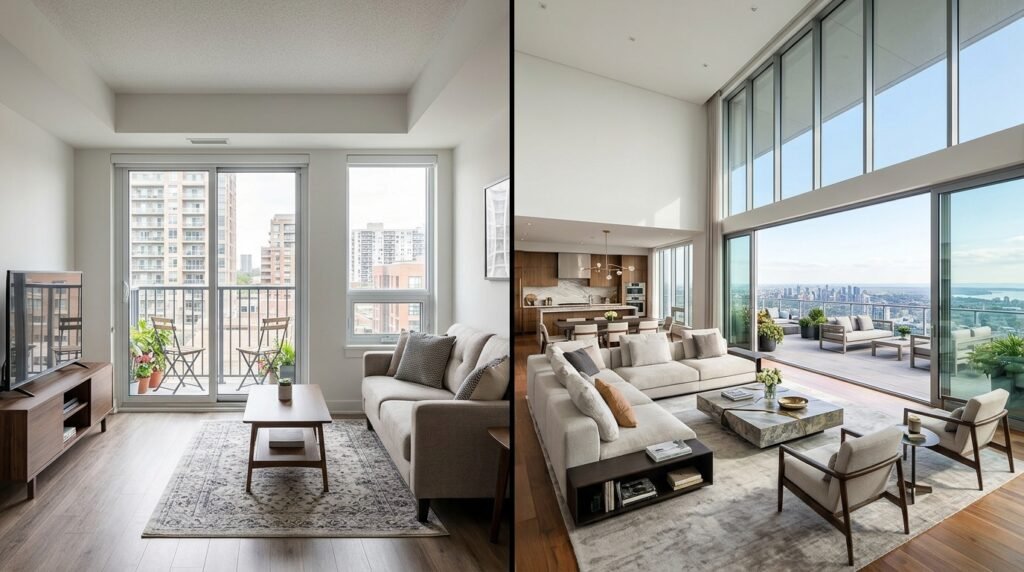
The main difference in penthouse vs apartment living is that a penthouse is a special type of apartment, usually located at or near the top of a residential building and commonly positioned as one of its premium residences. A standard apartment can be located on almost any residential floor and may range from a basic studio to a large luxury home. Penthouses often stand out through better views, greater privacy, larger or more distinctive layouts, private outdoor areas, premium finishes, and sometimes direct elevator access. These features are common rather than guaranteed. A penthouse does not have to occupy an entire floor, and not every penthouse is huge. Architectural Digest notes that penthouses generally occupy the upper level or levels of a building, while their layouts and amenities can vary widely. For renters and buyers, the better choice depends on budget, location, space needs, privacy, outdoor access, maintenance costs, and how much value they place on premium features.
What Is an Apartment?
An apartment is a self-contained residential unit within a larger building or residential complex. Apartments come in many forms, including studios, one-bedroom units, family-sized homes, duplexes, luxury residences, and other layouts. Depending on the market, an apartment may be rented, while individually owned units may commonly be described as condominiums. Terminology differs by country and property market, so the legal ownership structure should always be checked rather than assumed from the word “apartment.” Location within the building can also vary greatly. One unit may be near the lobby, another in the middle of a tower, and another on the highest residential level. This flexibility is important when comparing penthouse vs apartment options. “Apartment” describes a broad residential category, while “penthouse” describes a more specific position or premium type within that category. Standard apartments can still be expensive, spacious, luxurious, and highly desirable. The word apartment by itself does not mean small, inexpensive, or basic.
What Is a Penthouse?
A penthouse is generally an apartment or condominium occupying the top floor or part of the top floor of a building. Modern real estate also strongly associates the term with premium design and luxury. Architectural Digest explains that a penthouse does not necessarily need to occupy the entire top floor. Multiple residences can share a penthouse level, and penthouses can take forms such as duplexes, triplexes, or full-floor homes. Common features can include large terraces, expansive windows, higher ceilings, upgraded finishes, generous floor plans, private entrances, and direct elevator access. These are typical possibilities, not requirements. This distinction matters in a penthouse vs apartment comparison because marketing language can create unrealistic expectations. A listing labeled “penthouse” should be evaluated by its actual floor plan, position, outdoor space, privacy, views, specifications, and building services. The name alone does not tell you exactly what you are getting.
Penthouse vs Apartment: The Main Difference
The simplest way to understand penthouse vs apartment is to remember that a penthouse is generally a particular kind of apartment rather than an entirely separate form of housing. A standard apartment can occupy almost any residential level. A true penthouse traditionally occupies the uppermost residential level or levels and is often designed or marketed as a premium residence. The difference becomes more meaningful when you examine what that position can provide. Upper-level living may offer broader views, more daylight, less street-level disturbance, no upstairs neighbor, and opportunities for private terraces. Architectural Digest notes that top-floor penthouses often benefit from views, privacy, natural light, and outdoor space, although individual buildings vary. Standard apartments have their own advantages. They usually provide far more choices in size, floor level, layout, and price. Someone who values location and affordability more than exclusivity may therefore find a conventional apartment much more practical.
Location Within the Building
Floor position is one of the clearest differences when considering penthouse vs apartment properties. Standard apartments may occupy lower, middle, or upper floors. This gives residents flexibility. A lower-floor apartment can mean quicker access to the street and less dependence on elevators. A middle-floor residence may provide a useful balance between elevation and convenience. A penthouse sits at the upper end of the building and is valued partly because that position is limited. There may be only one penthouse, several penthouse-level units, or a multi-level residence spanning the building’s highest floors. Some full-floor penthouses have direct lift access and wraparound outdoor areas. Current luxury developments demonstrate that such arrangements still exist, although they should not be treated as universal penthouse features. When viewing either property type, think beyond the floor number. Consider elevator reliability, emergency access, building design, daily travel time, and how easily furniture and deliveries can reach the residence.
Space and Floor Plans
Penthouses are often larger than typical apartments in the same building, but size alone does not define them. A developer may combine substantial interior space with terraces, multiple bedroom suites, entertaining areas, larger kitchens, or unusual layouts. Some penthouses occupy a full floor, while others share the highest floor with neighboring units. Architectural Digest notes that penthouses can vary greatly in size and form and are not necessarily larger than every other residence. This makes floor-plan comparison essential in any penthouse vs apartment decision. Do not pay for a label when a lower-floor apartment provides a layout that works better. A well-designed 1,500-square-foot apartment can feel more useful than a larger residence with awkward corridors or rooms you rarely use. Look at usable interior space, storage, bedroom separation, kitchen layout, furniture placement, circulation, and outdoor areas. Buyers should also distinguish interior square footage from terraces and other exterior spaces when comparing listings.
Views and Natural Light
Views are among the strongest reasons people are attracted to penthouses. A high position can open sightlines across a city, waterfront, park, mountains, or surrounding neighborhood. Fewer nearby structures may also allow more daylight into the home. Large windows and multiple exposures can make that advantage even stronger. Architectural Digest identifies views and increased natural light among common penthouse benefits. Yet the penthouse vs apartment difference is not automatic. A lower apartment facing an open park may have a better view than a top-floor unit facing a neighboring tower or mechanical equipment. Orientation matters too. Strong afternoon sun can increase glare and heat, while beautiful floor-to-ceiling glazing may require shades or other solar-control measures. Visit the property during daylight when possible. Look through every major window rather than relying on listing photography. Consider what could be built nearby and whether the view is legally protected or simply unobstructed today.
Privacy and Neighbor Noise
Privacy can be one of the most meaningful penthouse advantages. A residence on the highest floor has no occupied apartment directly above it. Some designs also reduce shared walls or provide private elevator access. Architectural Digest notes that top-floor penthouse living can reduce interaction with neighbors and eliminate noise from an upstairs residence. In a penthouse vs apartment comparison, however, floor position is only one part of acoustic comfort. Elevators, mechanical rooms, rooftop equipment, shared terraces, gyms, lounges, and service areas can create noise in unexpected places. A well-insulated standard apartment can therefore be quieter than a poorly designed penthouse. Ask what sits above, below, and beside the unit. Visit at different times if possible. Buyers should review the building plans or ask management about rooftop equipment. Renters can also look for signs of elevator noise, door slamming, plumbing sounds, and activity in nearby common spaces before signing a lease.
Outdoor Space
Private outdoor space is a major attraction of many penthouses. Building setbacks and rooftop layouts can create room for terraces, roof decks, gardens, outdoor dining areas, or entertaining spaces. Architectural Digest notes that private rooftop or outdoor space is common in many penthouses, although it is not guaranteed. Standard apartments may instead have balconies, shared courtyards, communal rooftops, or no outdoor area at all. When assessing penthouse vs apartment living, do not judge outdoor space only by its size. Consider whether it is actually comfortable and usable. High elevations can bring stronger wind, intense sunlight, rain exposure, and temperature changes. Outdoor furniture, plants, drainage, waterproofing, and surface maintenance can require ongoing attention. Building rules may also restrict structures, grills, planting, parties, or alterations. A large terrace has little value if weather or regulations prevent you from using it the way you imagined.
Interior Finishes and Design
Developers often use penthouses to showcase a building’s highest specification. This can mean premium flooring, custom cabinetry, upgraded appliances, stone surfaces, larger windows, distinctive lighting, better bathroom finishes, or higher ceilings. Architectural Digest reports that penthouses are often distinguished by elevated interiors and higher-end finishes, though these features are not universal. Standard apartments may use more consistent finishes across the building, but luxury developments can provide excellent specifications at every level. For that reason, a penthouse vs apartment comparison should focus on materials rather than marketing terms. Check cabinet construction, flooring quality, windows, doors, fixtures, appliances, heating and cooling systems, and storage. Ask which features are included with the residence and which appeared only in a staged model. A beautiful countertop is easy to notice. Less visible factors such as glazing quality, sound insulation, ventilation, and waterproofing may have a greater effect on daily comfort.
Amenities and Private Access
A penthouse can sometimes provide privileges that ordinary apartments do not. Private or direct elevator access is one of the best-known examples. Some residences may also include dedicated foyers, private roof areas, additional parking, storage, or exclusive amenities. These features depend entirely on the building. They are not part of a universal penthouse definition. In the penthouse vs apartment decision, separate private amenities from building-wide amenities. A standard apartment in an excellent development may still include access to a pool, gym, concierge, lounge, garden, parking, security, and rooftop facilities. If both residences receive almost identical services, the penthouse premium may mainly pay for position, space, views, and finishes. Buyers should also check whether private features create additional maintenance responsibilities. A private elevator entrance sounds attractive, but access control, servicing arrangements, emergency procedures, and building management still matter.
Cost and the Penthouse Premium

Penthouses are usually among the most expensive residences within their buildings because their supply is limited and they can combine desirable features that lower units cannot easily copy. Architectural Digest notes that penthouses are typically the most expensive real estate within a building, although there is no fixed formula for a penthouse premium. The difference can vary dramatically according to the uniqueness of the property. This makes cost a central part of any penthouse vs apartment comparison. Do not compare only total purchase prices. Compare price per square foot, usable interior space, private outdoor space, view quality, parking, storage, finishes, and recurring charges. A penthouse costing substantially more may make sense to someone who strongly values privacy and a terrace. Another buyer may receive far better value from a large apartment a few floors below. The premium should be connected to benefits you will actually use rather than prestige alone.
Rent and Purchase Costs Are Only the Beginning
The higher entry price is not the only financial consideration. Larger residences can require more furniture, window treatments, heating, cooling, cleaning, and general upkeep. Private terraces can introduce landscaping, outdoor furniture, drainage, surface care, and weather-related maintenance. Architectural Digest also notes that carrying costs may be higher for penthouses because these homes are often larger or more valuable. Standard apartments may have lower recurring expenses, although building fees vary widely. When comparing penthouse vs apartment options, create a realistic monthly or annual ownership budget. Include rent or mortgage payments, building or association charges, insurance, utilities, parking, maintenance, and expected upkeep. Buyers should review the building’s financial documents and understand how shared expenses are allocated. Renters should ask which utilities and services are included. A residence that fits the purchase budget can still become uncomfortable financially if recurring costs were underestimated.
Temperature, Weather, and Exposure
Being at the top of a building creates benefits, but it also means greater exposure. Roofs and exterior walls can receive strong sun, wind, rain, and temperature changes. Large areas of glass can affect indoor comfort depending on orientation and glazing performance. Architectural Digest notes that penthouses can face weather-related considerations and additional maintenance associated with outdoor areas. In a penthouse vs apartment comparison, ask about heating and cooling rather than assuming higher automatically means more comfortable. Check the age and condition of HVAC systems, window specifications, shading, roof insulation, and any history of water intrusion. A middle-floor apartment may benefit from other conditioned units above and below it. A penthouse has the roof immediately overhead, making roof construction and maintenance especially relevant. None of these issues means penthouses are poor choices. They simply show why a spectacular view should not replace a careful inspection of building performance.
Convenience and Elevator Dependence
A lower-floor apartment can be surprisingly convenient. Walking downstairs may be practical when elevators are busy or temporarily unavailable. Moving groceries, receiving deliveries, walking a dog, or leaving the building several times per day can also be quicker. Penthouse residents usually depend more heavily on elevators because of the height involved. Some premium buildings reduce this inconvenience with fast lifts or private elevator access. Yet elevator dependence remains worth considering in a penthouse vs apartment decision. Ask how many elevators serve the building, whether there is a separate service elevator, and what happens during maintenance. Consider your own routine as well. Someone who works from home may care little about an extra elevator ride. A household making frequent trips outdoors may notice it every day. Accessibility also matters for residents and visitors with limited mobility. Luxury should make daily life easier, so practical circulation deserves as much attention as impressive interiors.
Security and Access
Penthouses can feel more private because fewer people may travel to their floor, and some buildings restrict elevator access using keys, cards, or resident credentials. Private lift foyers can further separate the residence from shared corridors. Standard apartments may have more passing foot traffic, especially when located near elevators, stairs, trash rooms, or amenities. Still, penthouse vs apartment security depends much more on the complete building system than the unit label. Look at controlled entrances, elevator access, concierge or security arrangements, cameras in permitted common areas, parking access, visitor procedures, locks, fire exits, and emergency communication. Private elevator access should not be confused with complete independence from the building. Penthouse residents still depend on shared infrastructure and building safety systems. Buyers and renters should understand how visitors, staff, deliveries, and contractors reach their floor and residence before deciding whether the access arrangement provides the level of privacy they expect.
Maintenance Responsibilities
Standard apartment residents generally deal with the interior of their units while building management handles common areas and major shared systems, although the exact division depends on the lease, ownership documents, and local rules. Penthouse residents may have additional features that blur these lines. A private terrace, rooftop garden, exclusive elevator landing, fireplace, pool, or other special feature can raise questions about who maintains and repairs it. This is an overlooked part of penthouse vs apartment ownership. Never assume the building will pay for every exterior feature simply because it is attached to the property. Review the relevant documents carefully. Determine who handles terrace waterproofing, drains, railings, doors, landscaping, exterior surfaces, and private equipment. Renters should have similar questions clarified in their lease. A feature can be enjoyable when responsibilities are clear but frustrating when repair costs and access obligations become a surprise.
Penthouse vs Apartment for Families
Families should choose based on daily function rather than status. A large penthouse may provide generous bedrooms, entertaining space, outdoor areas, privacy, and storage. It can feel closer to a private home while retaining apartment-building services. Yet a well-planned standard apartment can meet family needs just as effectively and may cost much less. When comparing penthouse vs apartment choices for a family, look closely at bedroom separation, child safety, balcony and terrace design, storage, laundry facilities, elevator access, parking, schools, nearby outdoor spaces, and travel time. Very high outdoor areas require careful supervision and appropriate safety features. Parents should also consider whether a spectacular terrace will actually be used by the household. Paying a large premium for spaces that remain empty rarely makes practical sense. A family with young children may value a building near a park more than a private roof terrace. Lifestyle should drive the decision.
Penthouse vs Apartment for Renters
Renters usually have a simpler decision because they do not carry the same long-term resale risk, but the financial difference can still be significant. A penthouse rental may offer better views, fewer upstairs noise problems, outdoor space, and premium finishes. A standard apartment may provide access to the same building amenities for considerably less rent. The smartest penthouse vs apartment rental comparison focuses on what the extra monthly payment actually buys. Tour both options if possible. Compare natural light, noise, usable space, storage, outdoor areas, included parking, utilities, and building services. Check whether the penthouse has higher heating or cooling costs and whether terrace maintenance is included. Read the lease carefully for restrictions on outdoor spaces. If the only meaningful difference is the floor number and view, decide how much those benefits are worth each month. Renting can also be a practical way to experience top-floor living before making a future purchase.
Penthouse vs Apartment for Buyers
Buyers need to examine both the residence and the building. A penthouse may be scarce and distinctive, but uniqueness alone does not guarantee that it is the best investment or home. Review comparable sales carefully because unusual layouts can be harder to compare with ordinary units. In a penthouse vs apartment purchase, inspect roof condition, terraces, drainage, windows, HVAC equipment, elevators, building finances, insurance, reserve funds, association documents, and planned assessments where applicable. Determine exactly which areas are privately owned and which are common or limited common elements. A beautiful roof terrace deserves special attention because waterproofing failures can be expensive and disruptive. Standard apartments require due diligence too, but penthouses can include more unique components. Resale demand also varies by location and market. Buy the residence because its combination of layout, location, cost, condition, and lifestyle works for you rather than assuming the word “penthouse” guarantees future appreciation.
Common Misconceptions About Penthouses
One misconception is that every penthouse occupies an entire floor. It does not. Architectural Digest notes that a penthouse can occupy only part of the top floor, and several residences may exist at that level. Another misconception is that every penthouse is enormous. Size varies greatly. A third is that all penthouses have private elevators, pools, rooftop gardens, and floor-to-ceiling windows. Those are possible luxury amenities rather than defining requirements. These misconceptions can distort a penthouse vs apartment comparison because buyers begin comparing an imagined luxury home with an actual standard unit. Instead, compare the real properties. A large corner apartment on a high floor may provide exceptional views and privacy without carrying the penthouse label. Conversely, a small top-floor residence may technically qualify as a penthouse while lacking many expected luxury features. Property details matter more than terminology.
How to Compare Two Properties Properly
A useful comparison begins with the features that affect everyday life. Start with total cost and usable interior space. Then compare layout, storage, natural light, views, privacy, noise, outdoor space, finishes, parking, amenities, elevator access, maintenance, and monthly charges. For a penthouse vs apartment decision, give each feature a personal value rather than assuming the penthouse automatically wins. If you rarely entertain outdoors, a huge terrace may not justify a major premium. If quiet and privacy are your highest priorities, having no upstairs neighbor may matter every day. Visit each property more than once when possible. Daylight, traffic, elevator activity, wind, and neighborhood noise can change throughout the day. Buyers should obtain appropriate professional inspections and review ownership documents. Renters should inspect the lease and clarify maintenance responsibilities. The best residence is the one whose advantages match your actual routine.
Which One Offers Better Value?
There is no universal winner. A penthouse can offer excellent value to someone who wants privacy, premium outdoor space, expansive views, and a distinctive home and can comfortably afford the added cost. A standard apartment often provides better financial efficiency because residents can live in the same neighborhood or building while paying less for features they value more. That is the central lesson of penthouse vs apartment value. Do not confuse “better” with “more expensive.” Think in terms of benefit per dollar and benefit per square foot. A lower-floor apartment with a better layout can be the stronger home. A rare penthouse with a usable terrace and unobstructed views can justify its premium for the right buyer. Location remains critical too. A conventional apartment in an excellent neighborhood may fit your lifestyle better than an impressive penthouse far from work, family, schools, or the places you visit most often.
Frequently Asked Questions
What is the main difference in penthouse vs apartment living?
The main penthouse vs apartment difference is position and typical level of exclusivity. A penthouse generally occupies the uppermost residential level or levels and is often designed as a premium residence. An apartment is the broader category and can be located on almost any floor. Penthouses commonly offer better views, privacy, terraces, or premium finishes, but these features are not guaranteed.
Is a penthouse always on the top floor?
Traditionally, a penthouse occupies the top floor or part of the top floor of a building. Architectural Digest notes that it does not have to occupy the entire floor and may form part of a duplex or triplex. Some developments use “penthouse” more broadly as a marketing term, so buyers should confirm the residence’s actual position.
Are penthouses always bigger than apartments?
No. Penthouses are often large, but there is no rule requiring them to be bigger than every other apartment. Architectural Digest notes that penthouses vary widely in size and configuration. Always compare actual interior square footage and floor plans rather than assuming the penthouse label guarantees more usable space.
Why are penthouses usually more expensive?
Penthouses can command a premium because top-floor space is limited and may offer better views, privacy, natural light, outdoor areas, larger layouts, and upgraded finishes. Architectural Digest notes that they are typically among the most expensive residences in a building, although there is no standard formula for calculating the premium.
Is a penthouse quieter than a regular apartment?
It can be quieter because there is normally no residential neighbor directly above the top floor. However, rooftop mechanical equipment, elevators, terraces, and building systems can create other sounds. Construction quality and unit position are therefore just as important as floor level when evaluating noise.
Is buying a penthouse worth it?
It can be worth it when you genuinely value the features that create the premium, such as views, privacy, outdoor space, larger rooms, or unique design. If those benefits matter little to you, a standard apartment in the same building may offer better value. Buyers should also compare recurring costs and maintenance responsibilities before deciding.
Conclusion
The penthouse vs apartment choice is ultimately about priorities rather than prestige. A penthouse is generally a premium apartment at the top of a building, and it may provide stronger views, greater privacy, distinctive layouts, private outdoor space, and upgraded finishes. Those benefits often come with higher purchase or rental prices, greater carrying costs, increased weather exposure, and possible maintenance responsibilities. A standard apartment offers far more variety and can deliver the same neighborhood, building amenities, security, and convenience at a lower cost. Compare real properties rather than labels. Study the floor plan, usable space, view, noise, outdoor areas, access, recurring expenses, building condition, and maintenance obligations. If the penthouse features improve your everyday life enough to justify their premium, the upgrade can make sense. If they do not, a thoughtfully chosen standard apartment may be the smarter and more comfortable home.